What Is Segmentation in Operating System?
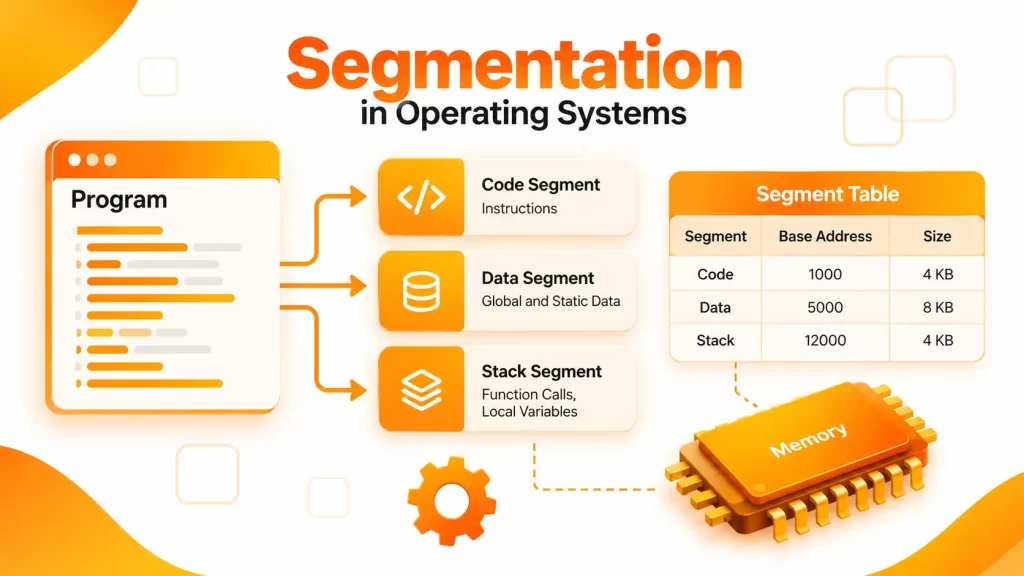
Segmentation in operating system is a memory management technique that divides a program’s logical address space into different segments based on how the program is organized. Instead of treating the entire program as one continuous block of memory, the operating system separates it into meaningful parts such as the code segment, data segment, and stack segment.
Each segment can have a different size because programs do not always require the same amount of memory for every part. The operating system keeps information about these segments in a segment table, which helps identify the location and size of each segment in physical memory.
This approach provides a logical view of memory because each segment represents a specific part of a program. For example, instructions can be placed in the code segment, program data can be stored in the data segment, and temporary function-related information can be handled through the stack segment. As a result, segmentation connects the way a program is logically organized with the way its memory is managed.
Definition of Segmentation in OS
Segmentation divides a program’s logical address space into separate variable-sized segments, with each segment representing a meaningful part of the program. Unlike fixed-size memory blocks, these segments can have different sizes according to the memory requirements of the code, data, or other program components.
For example, a program may contain a code segment for instructions, a data segment for stored program data, and a stack segment for stack-related information. Since these parts serve different purposes, keeping them as separate segments gives the operating system a more logical way to organize and manage memory.
To manage these segments, the operating system maintains a segment table containing details such as the segment’s location and size. When a program accesses memory, the system uses this information to determine the corresponding location in physical memory. This connection between the program’s logical structure and its memory locations is what makes segmentation an important memory management technique.
How Segmentation Works in Operating Systems?
- A program is divided into separate segments according to its logical structure, such as code, data, and stack.
- Each segment can have a different size because segmentation uses variable-sized memory segments rather than fixed-size blocks.
- The operating system assigns a segment number to identify each segment within the program’s logical address space.
- Details about every segment are maintained in a segment table, which provides information needed to locate that segment in memory.
- Each segment has a base address, which indicates the starting location of that segment in physical memory.
- The size of the segment is also maintained so that the operating system can check whether a memory access stays within the segment’s boundaries.
- When a program generates a logical address, the address contains information that identifies the required segment along with the position within that segment.
- The operating system uses the segment information from the segment table to determine the corresponding physical address.
- This process allows different segments to be placed in different locations, supporting non-contiguous memory allocation.
- Because each segment represents a meaningful part of a program, segmentation provides a logical way to organize and manage memory.
Logical Address and Physical Address in Segmentation
- A logical address is the address generated by a program when it needs to access a particular location in memory.
- In segmentation, the logical address identifies the required segment along with the position of the required data within that segment.
- The segment number helps the operating system identify the corresponding entry in the segment table.
- The segment table contains information about the segment, including its base address and size.
- The base address indicates the starting memory location of the segment in physical memory.
- The position within the segment is used along with the base address to determine the required location.
- The resulting location is called the physical address, which refers to the actual location in main memory.
- The operating system also checks the segment size before allowing access, helping maintain the defined boundaries of the segment.
- This relationship between logical and physical addresses allows segmentation to connect a program’s logical memory structure with its actual memory allocation.
How Memory Segmentation Works?
Memory segmentation organizes a program’s memory into variable-sized segments, allowing each part of the program to be managed according to its purpose and memory requirements. The operating system uses the segment table to keep track of each segment’s location and size, which helps connect the program’s logical address space with its actual memory location. This approach provides a logical structure for memory allocation while allowing different segments to occupy separate areas of memory.
Segment Number, Base Address, and Segment Size
| Term | Meaning | Role in Segmentation |
| Segment Number | Identifies a particular segment of a program. | Helps the operating system locate the correct entry in the segment table. |
| Base Address | Represents the starting memory location of a segment. | Used to locate where the selected segment begins in physical memory. |
| Segment Size | Specifies the amount of memory occupied by a segment. | Helps determine the valid range of addresses within that segment. |
| Segment Table | Stores information about the segments, including their locations and sizes. | Connects the logical address generated by a program with its corresponding physical memory location. |
Role of the Segment Table
- The segment table keeps the information needed to manage the different segments of a program.
- Each segment has an entry in the table that helps the operating system identify its memory location.
- The table provides the base address, which indicates where a particular segment starts in physical memory.
- It also stores the size of the segment, allowing the operating system to identify the valid memory range for that segment.
- When a program generates a logical address, the operating system uses the segment number to find the relevant entry in the segment table.
- The information in that entry helps the system determine the corresponding physical address.
- The segment table therefore connects the program’s logical address space with the actual memory allocated to its segments.
- By maintaining this information separately for each segment, the operating system can manage variable-sized memory allocation more systematically.
How a Logical Address Is Converted to a Physical Address?
- The process starts when a program generates a logical address to access a particular location within its memory space.
- The logical address identifies the segment number and the position of the required location within that segment.
- The operating system uses the segment number to find the corresponding entry in the segment table.
- The segment table provides the base address of the selected segment in physical memory.
- The position within the segment is then used with the base address to determine the required physical address.
- Before allowing the access, the operating system checks the segment’s size to ensure that the requested location remains within its defined boundary.
- This process connects the logical view of a program’s memory with the actual memory location where its segment is stored.
Types of Segments in an Operating System
In segmentation, a program is divided into different segments according to the purpose of the information stored in each part. Common examples include the code segment, data segment, and stack segment. Each segment represents a distinct part of the program’s logical address space, allowing the operating system to manage these parts separately based on their memory requirements.
Code Segment
- The code segment contains the instructions or executable code that make up a program.
- It represents one logical part of the program’s address space.
- Keeping program instructions in a separate segment allows the operating system to manage them independently.
- The code segment works alongside other segments, such as the data and stack segments, to organize the program in memory.
Data Segment
- The data segment stores the data used by a program during its execution.
- It forms a separate part of the program’s logical address space.
- Keeping data in its own segment allows it to be managed separately from program instructions.
- The data segment can have its own size and memory location, depending on the program’s requirements.
Stack Segment
- The stack segment is a separate part of a program’s logical address space.
- It is used for information associated with the program’s stack during execution.
- Like other segments, it can have its own size and memory location.
- Keeping the stack as a separate segment helps organize different memory requirements within the program.
Why Is Segmentation Used in Operating Systems?
Segmentation is used to organize a program’s logical address space into meaningful parts and manage each part separately. Since different segments can have different sizes and memory requirements, this approach supports flexible memory allocation and provides a structured way to manage program memory. It can also support memory protection and separate access rights for different segments, depending on the system’s implementation.
Memory Protection and Access Rights
- Memory protection helps control how different segments can be accessed during program execution.
- Since each segment represents a separate part of the program’s address space, access can be managed according to the purpose of that segment.
- The operating system can use access rights to determine which types of memory access are permitted for a particular segment.
- This separation helps prevent an operation from accessing a memory area outside the segment’s defined boundaries.
- As a result, segmentation provides a structured approach to managing memory protection while handling different segments independently.
Process Isolation and Memory Sharing
- Segmentation separates a program’s memory into different segments, giving each part a defined area within the logical address space.
- This separation can help the operating system manage memory access between different parts of a program.
- Memory protection and access rights can be associated with individual segments, helping control how those areas are accessed.
- Segments can also support memory sharing when the system allows selected memory areas to be accessed by more than one process.
- In this way, segmentation provides a structured approach to managing memory while keeping different parts of a program logically separated.
Non-Contiguous Memory Allocation
- Segmentation allows different segments of a program to be placed in separate locations in physical memory.
- Because segments are variable-sized, each one can be allocated according to its individual memory requirements.
- The segments do not need to occupy one continuous block of physical memory.
- The segment table keeps track of the location and size of each segment, helping the operating system manage these separate memory areas.
- This provides a logical way to organize program memory while supporting non-contiguous memory allocation.
Advantages and Disadvantages of Segmentation
Segmentation provides a logical way to organize program memory by dividing it into separate, variable-sized segments. This structure can support flexible memory allocation and memory protection, but it can also create memory management challenges such as external fragmentation.
Advantages of Segmentation in OS
- Segmentation organizes a program into meaningful variable-sized segments based on its logical structure.
- It supports flexible memory allocation because different segments can require different amounts of memory.
- Separate segments can have their own access rights, supporting controlled memory access.
- It provides a logical view of memory by keeping parts such as code, data, and stack in distinct segments.
- Segments can be placed in different memory locations, supporting non-contiguous memory allocation.
Disadvantages of Segmentation in OS
- Segmentation can lead to external fragmentation because memory is allocated to variable-sized segments.
- As segments are created and released, free memory can become divided into smaller blocks.
- These separate free blocks may make memory allocation more difficult when a larger segment is required.
- Managing variable-sized segments also requires the operating system to keep track of the size and location of different memory blocks.
- Therefore, although segmentation provides a logical approach to memory management, memory fragmentation can become a challenge.
External Fragmentation and Memory Usage
- External fragmentation occurs when free memory becomes divided into separate blocks after variable-sized segments are allocated and released.
- These free blocks may be available in total, but they can be separated across different memory locations.
- Since segmentation uses variable-sized segments, the pattern of free memory can change as segments are added and removed.
- This can make future memory allocation more difficult when a segment needs a suitable continuous space.
- Therefore, external fragmentation can affect how efficiently available memory space is used in a segmented memory system.
Segmentation and Paging in Operating Systems
Segmentation and paging are both memory management techniques, but they organize memory differently. Segmentation divides a program into variable-sized segments based on its logical structure, while paging divides memory into fixed-size blocks. Understanding this difference helps explain why operating systems may use paging, segmentation, or a combination of both.
Paging vs Segmentation
| Feature | Paging | Segmentation |
| Memory division | Divides memory into fixed-size blocks. | Divides a program into variable-sized segments. |
| Basis of division | Uses a fixed block size. | Uses the logical structure of the program. |
| Segment or block size | Blocks have a fixed size. | Segments can have different sizes. |
| Logical organization | Does not directly represent program modules. | Each segment can represent a meaningful program part, such as code or data. |
| Fragmentation | Can result in internal fragmentation. | Can result in external fragmentation. |
| Address structure | Uses page-related addressing. | Uses a segment number and position within the segment. |
| Memory management | Focuses on fixed-size memory allocation. | Focuses on variable-sized memory allocation. |
Segmentation in Virtual Memory
Segmentation can be discussed as part of virtual memory and memory management, where a program’s logical address space is organized into separate segments. Each segment can represent a meaningful part of the program and can have its own size and memory requirements. This connects segmentation with broader memory management concepts such as address spaces, memory allocation, and the organization of program memory.
Role of Segmentation in Memory Management
- Segmentation provides a logical view of memory by dividing a program into meaningful segments.
- Each segment can have its own size and memory requirements, allowing the operating system to manage them separately.
- The segment table helps keep track of information associated with these different segments.
- This structure connects memory allocation with the logical organization of a program.
- Segmentation can also work with other memory management approaches, such as paging, to organize and manage program memory.
Variable-Sized Segments and Memory Allocation
- Variable-sized segments allow different parts of a program to occupy different amounts of memory.
- The size of each segment can depend on the memory requirements of that particular part of the program.
- This approach allows the operating system to perform memory allocation according to the size of each segment rather than using one fixed size for every segment.
- The segment table keeps track of information such as the segment’s location and size, helping the system manage the allocated memory.
- Because segments have different sizes, the available memory can become divided into separate free areas, which is related to external fragmentation.
Segmentation Fault in Operating Systems
A segmentation fault is different from segmentation as a memory management technique. Segmentation organizes a program’s memory into separate segments, while a segmentation fault refers to an invalid memory access. Understanding this distinction helps avoid confusing the two terms when studying memory management in an operating system.
What Causes a Segmentation Fault?
- A segmentation fault occurs when a program attempts to access a memory location that it is not permitted to access.
- This is different from segmentation in operating system, which is a technique for organizing a program’s memory into separate segments.
- The term segmentation fault is therefore related to memory access, rather than the process of dividing memory into code, data, or stack segments.
- Understanding this difference helps avoid confusing a segmentation fault with memory segmentation when studying operating system memory management.
Segmentation Fault vs Segmentation
| Aspect | Segmentation | Segmentation Fault |
| Meaning | A memory management technique that divides a program into separate segments. | An error caused by an invalid memory access. |
| Purpose | Organizes a program’s logical address space into meaningful parts. | Indicates that a program attempted an access that is not permitted. |
| Memory concept | Uses segments such as code, data, and stack. | Relates to accessing a memory location outside the permitted area. |
| Relation to OS | Used as part of memory management. | Occurs when the operating system detects an invalid memory access. |
| Key idea | Focuses on organizing and managing memory. | Focuses on an invalid memory access. |
Segmentation in Modern Operating Systems
Segmentation is a memory management technique that organizes a program’s logical address space into separate, variable-sized segments. The provided SEO brief also connects this concept with segmentation with paging, showing how segmentation can be discussed alongside other memory management approaches.
How Modern Systems Handle Segmentation?
- Modern operating systems can use segmentation as part of their broader approach to organizing and managing memory.
- Segmentation provides a logical view of memory by separating a program into meaningful segments.
- Different segments can have different sizes because segmentation uses variable-sized memory areas.
- The operating system can maintain information about these segments through a segment table, including their location and size.
- Segmentation can also be combined with paging, allowing both logical segmentation and fixed-size memory blocks to be considered together.
- The exact way segmentation is handled can vary across modern operating systems and memory-management designs.
Segmentation with Paging in Modern Memory Systems
- Segmentation with paging combines the logical organization of segmentation with the fixed-size block structure used in paging.
- A program can be viewed as separate segments, while the memory associated with those segments can be managed using fixed-size pages.
- This approach connects segmentation and paging within a broader memory management design.
- It allows the logical structure of a program to be considered while memory is organized into fixed-size blocks.
- The combination is therefore useful when discussing how different memory management techniques can work together in an operating system.
Common Misconceptions About Segmentation in OS
- Segmentation and segmentation faults are not the same. Segmentation is a memory management technique, while a segmentation fault refers to an invalid memory access.
- Segmentation is not the same as paging. Segmentation uses variable-sized segments, whereas paging uses fixed-size blocks.
- Segmentation does not require all parts of a program to occupy one continuous memory area. Different segments can be allocated in different memory locations.
- A segment does not have a fixed size. The size of a segment can vary according to the memory requirements of the corresponding program part.
- Segmentation is not limited to one type of program data. A program can have different segments, such as code, data, and stack segments.