Introduction
Software Testing is considered one of the easiest ways to enter into the IT Field. Software Testing is the one, where one can apply their logical thinking functionally as well as programmatically. A Tester can get both Functional and Technical Knowledge. That is the beauty of Software Testing. Technical Knowledge can be obtained through Functional Automation and Non-Functional Performance Testing.
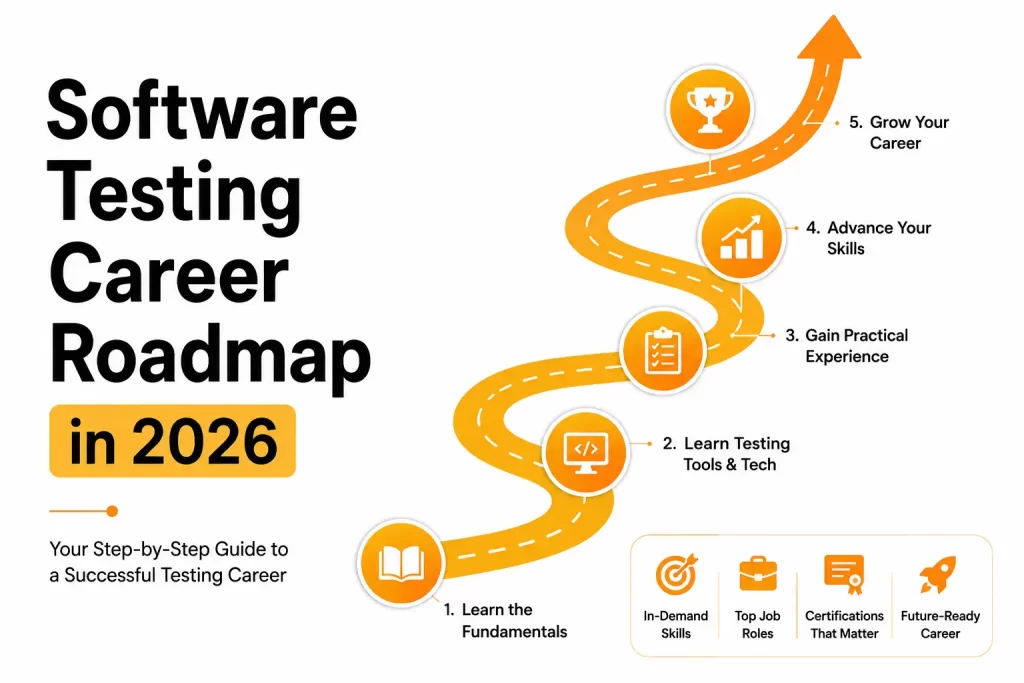
Many may wonder ‘Is Still (in the AI era) Software Testing a good way to start?’. But the answer is ‘Yes, Software Testing is still one of the best ways to start an IT Career’. The United States Bureau of Labor Statistics projects 15 % growth (2024–2034) for software quality assurance analysts and testers, much faster than the average for all occupations. In this post, we are going to discuss Software Testing Career, Its Road Map and Career Path step-by-step.
What is Software Testing and the Role of a Tester?
Responsibilities of a Software Tester
Software Testing is all about testing the Quality of a Software. This software either can be a Product or an Application Software. A Software Tester is part of the Product from the initial stages. Once the Unit Testing is done from the Developer side, Tester gets involved in Integration Testing, System Testing and UAT(User Acceptance Testing). Doing all these testing through Manual or Automation way entirely depends on the time duration given for testing and the complexity of the software. In general, moving to automation is the right way nowadays, where we have Weekly / Biweekly releases. Selenium, Playwright are the major Open Source Automation Tools in the Industry.
Step-by-Step Software Testing Career Roadmap for Beginners
Beginner Level – Manual Testing Foundation
Before entering into Automation Testing, one must know the foundation of Functional Testing thoroughly. Where to Start Testing, When to Start Testing, and How to are the three important areas a Tester should be aware of. For getting a clear picture on this, Knowledge on Software Development Life Cycle(SDLC) and Software Testing Life Cycle is important. In SDLC, one will get to know where to and how to do specific testing. Knowing how to write test cases is an important part in Software Testing initially, Knowing how to raise this as a bug and report it to the Developer is another important part later. Bugzilla is one such tool to gain knowledge on Bug Life Cycle. To gain Real Software Testing experience, there are a number of Open Source Software available. LibreOffice, Notepad++, VLC Media Player are few of the Open Source Tools where one can get real Software Testing experience.
Intermediate LevelMoving from Manual to Automation
The very first part is doing Testing through manual ways. Once the Software is familiarised with manual ways, moving to Automation is the very next step. Automation is the right choice in the fast paced programming world where multiple releases are expected in a month. Along with its speed, Automation provides us Accuracy too. This is the main reason many organizations opt for Automation Testing. Though there are a number of paid Automation Tools available, Selenium and Playwright are two familiar Open Source and free tools for Automation.
Programming and Technical Skills Required for Automation Testing
- ✔️ Once a Software Tester gains confidence in Manual Testing, the next step is to learn the technical skills required for Automation Testing. Today, most companies prefer Automated Testing because it helps complete repetitive testing activities faster and with better accuracy. To become an Automation Tester, learning a Programming Language and understanding the basic technical concepts are equally important.
- ✔️ Many beginners think that they need to become expert programmers before starting Test Automation. In reality, that is not true. A Tester only needs a strong foundation in programming and should know how to write simple programs, understand application logic, and create Test Scripts for automation. As experience grows, these programming skills also improve naturally through continuous practice.
- ✔️ Among the available options, Java, Python, and JavaScript are the most commonly used programming languages for Software Testing and Automation. Selenium is widely used with Java and Python, while Playwright supports JavaScript, Java, Python, and C#. Learning any one programming language thoroughly is enough to begin your Software Testing Career Roadmap. Once the basics are clear, learning another language becomes much easier.
- ✔️ Apart from programming, an Automation Engineer should also understand Object-Oriented Programming (OOP) concepts such as Class, Object, Inheritance, Polymorphism, Abstraction, and Encapsulation. These concepts help in designing reusable and maintainable automation Frameworks. A well-designed framework reduces code duplication and makes Test Automation easier to manage when the number of Test Cases increases.
- ✔️ Along with programming knowledge, it is also important to understand basic technical topics such as File Handling, Exception Handling, Collections, Loops, Conditional Statements, and Functions. These concepts help an Automation Tester write better automation scripts and solve real-time problems during project execution.
- ✔️ Version control is another important skill in today’s Software Development environment. Most organizations use GitHub to store automation projects and collaborate with team members. Learning basic Git commands such as Clone, Commit, Push, Pull, and Branching will help you work efficiently with other QA Professionals and developers.
- ✔️ As your Software Testing Skills improve, you should also gain basic knowledge of DevOps concepts and Continuous Integration tools. Modern automation projects are executed automatically whenever developers update the application. Understanding how automation fits into the overall Software Development Life Cycle (SDLC) will help you become a complete Automation Tester and improve your Career Growth opportunities.
- ✔️ The most important point to remember is that programming is not meant to replace your testing knowledge. Instead, it helps you Automate repetitive work while applying your Testing Concepts effectively. When strong functional knowledge is combined with technical skills, you can confidently move from a Manual Tester to an Automation Engineer and build a successful Career Path in Software Testing.
Programming Language for Test Automation
Learning a Programming Language is one of the first technical steps in Automation Testing. You do not need to become a software developer, but understanding the basics will help you write, understand, and maintain automation scripts with confidence.
- ✔️ Learn Java or Python BasicsStart with variables, data types, operators, loops, conditional statements, functions, and exception handling. Both Java and Python are widely used for Test Automation, and learning either one provides a strong foundation for your automation journey.
- ✔️ Understand OOP ConceptsLearn the basic Object-Oriented Programming (OOP) concepts such as Class, Object, Inheritance, Polymorphism, Abstraction, and Encapsulation. These concepts are important for creating reusable and maintainable automation code.
- ✔️ Practice with Real ProgramsWrite simple programs every day and gradually move towards automation-related examples. Regular practice helps improve your programming skills and prepares you for working with automation frameworks in real projects.
Automation Tools to Learn
After learning the basics of programming, the next step is to work with an Automation Tool. Choosing the right tool and understanding its core concepts will help you build reliable and reusable Test Automation scripts.
- ✔️ Learn Selenium BasicsSelenium is one of the most popular open-source tools used for Automation Testing. Learn how to locate web elements, perform user actions, handle web pages, and create basic automated test scripts.
- ✔️ Understand Automation Framework ConceptsLearn how automation frameworks organize test scripts, test data, reports, and reusable methods. A well-designed Framework makes automation projects easier to maintain and improves code reusability.
- ✔️ Work on Hands-on ProjectsPractice automating real web applications using Selenium and build small automation projects. Working on real scenarios improves your confidence and gives you practical experience that is valuable during interviews and in the workplace.
API Testing and Advanced Testing Skills
As you become comfortable with Automation Testing, the next step is to learn advanced Software Testing Skills that are widely used in real projects. One of the most important skills is API Testing. Today, most Software Applications are built using APIs, and testing them helps identify issues even before the user interface is developed. Learning API Testing also improves your understanding of how different systems communicate with each other.
Along with API Testing, you should also gain knowledge of Performance Testing, Regression Testing, and other Types of Testing based on your career goals. These additional skills make you a more valuable Test Engineer and open up better Job Opportunities in the software industry. As your technical knowledge grows, you can confidently move towards advanced Testing Roles and strengthen your Software Testing Career Path.
API Testing for Test Engineers
Learning API Testing is an important step for every Test Engineer because many modern applications depend on APIs for data exchange. Understanding how APIs work helps testers validate business logic without depending completely on the user interface.
- ✔️ Understand REST APIsLearn the basics of REST APIs, including HTTP methods such as GET, POST, PUT, and DELETE, along with request headers, response codes, and JSON data. This knowledge helps you test how applications communicate with each other.
- ✔️ Learn Postman BasicsPostman is one of the most popular tools for API Testing. Learn how to create requests, send API calls, validate responses, manage collections, and automate simple API test scenarios.
- ✔️ Practice Real-Time API TestingWork with sample APIs and perform functional validation, error handling, and response verification. Hands-on practice improves your Software Testing Skills and prepares you for real project requirements.
Certifications for Software Testing Career Growth
Having good practical knowledge is always the first priority in Software Testing. However, earning a recognized Certification can strengthen your resume and demonstrate your understanding of testing concepts. Certifications become more valuable when they are supported by real project experience and strong practical skills.
Among the available Software Testing Certifications, ISTQB is one of the most widely recognized across the industry. While certifications alone cannot guarantee a job, they can improve your profile, especially for freshers and professionals looking for Career Growth. The right combination of practical experience, technical knowledge, and certification helps you build a successful Software Testing Career.
Software Testing Certifications and ISTQB
A professional Certification helps validate your knowledge of testing principles and industry practices. It is recommended to focus on learning first and then appear for certification once your fundamentals are clear.
- ✔️ Know When to Take CertificationComplete your Manual Testing, basic Automation Testing, and practical projects before preparing for ISTQB or other Software Testing Certifications. This makes it easier to understand the concepts and perform well in the examination.
- ✔️ Learn About ISTQBISTQB is one of the most recognized certifications for software testers. It covers testing fundamentals, testing techniques, test management, and quality assurance concepts that are commonly followed in the software industry.
- ✔️ Understand the Career BenefitsA certification improves your resume, increases your confidence during interviews, and supports your long-term Career Growth. When combined with strong practical experience and technical skills, it helps you stand out for better QA and Automation Tester opportunities.
Testing Career Path and Job Roles in 2026
The Software Testing Career Path offers excellent opportunities for continuous learning and Career Growth. As you gain experience, your responsibilities increase from executing Test Cases to designing automation frameworks, leading testing teams, and managing complete Quality Assurance processes. The key to long-term success is to build a strong foundation, gain Hands-on Experience, and continuously improve your Software Testing Skills.
Key Points
- ✔️ Start with Strong FundamentalsBegin your journey as a Manual Tester by learning Testing Concepts, SDLC, Software Development Life Cycle, Test Management, JIRA, and different Testing Methods. A strong foundation makes it easier to move towards automation.
- ✔️ Move from Manual to AutomationAs your experience grows, learn a Programming Language, Selenium, API Testing, Postman, GitHub, and automation Frameworks. These technical skills help you become an Automation Tester and improve your career opportunities.
- ✔️ Keep Learning for Career GrowthStay updated with new Automation Tools, AI Testing, Performance Testing, DevOps, and industry best practices. Continuous learning helps you advance through different Testing Roles and build a successful Software Testing Career Roadmap in 2026.
Testing Roles and Career Opportunities
| Career Stage | Experience | Primary Responsibilities | Skills to Focus On |
| QA / Manual Tester | 0–2 Years | Execute Test Cases, report defects, perform Manual Testing, validate requirements, and ensure Software Quality. | SDLC, STLC, Testing Concepts, JIRA, Test Case Writing, Bug Reporting |
| Senior QA Engineer | 2–4 Years | Handle complex test scenarios, mentor junior testers, perform Regression Testing, participate in test planning, and improve the testing process. | Advanced Testing Skills, Test Management, API Testing, Communication, Best Practices |
| Automation Tester / Automation Engineer | 3–6 Years | Develop Test Automation scripts, maintain automation Frameworks, execute automated regression suites, and integrate automation into CI/CD pipelines. | Java/Python, Selenium, Playwright, API Testing, Postman, GitHub, Automation Frameworks |
| QA Lead / Test Lead | 6–9 Years | Lead the QA team, assign tasks, review automation strategy, manage testing schedules, and ensure the quality of software applications. | Leadership, Test Planning, Risk Management, DevOps Basics, Team Coordination |
| QA Manager / Test Manager | 9+ Years | Define testing strategy, manage multiple projects, improve quality assurance processes, allocate resources, and guide testing teams to achieve business goals. | People Management, Test Strategy, Process Improvement, Stakeholder Communication, Project Management |
Final Step-by-Step Roadmap to Become a Software Tester in 2026
The following Step-by-Step Roadmap provides a clear learning path for anyone who wants to build a successful Software Testing Career in 2026. Follow each stage in order and focus on gaining practical knowledge before moving to the next one.
| Step | What to Learn | Expected Outcome |
| Step 1 | Learn the fundamentals of Software Testing, SDLC, STLC, and different Types of Testing. | Build a strong foundation in software testing concepts and quality assurance. |
| Step 2 | Practice Manual Testing, write Test Cases, create Test Scenarios, report bugs using JIRA, and understand the testing process. | Develop practical experience in functional testing and defect management. |
| Step 3 | Learn a Programming Language such as Java or Python along with basic OOP concepts. | Prepare yourself for automation testing and technical interview rounds. |
| Step 4 | Learn Selenium or Playwright, understand automation Frameworks, and write basic Test Scripts. | Move successfully from Manual Testing to Automation Testing. |
| Step 5 | Learn API Testing using Postman, understand REST APIs, and validate API responses. | Improve your software testing skills and become a complete tester. |
| Step 6 | Learn GitHub, basic DevOps concepts, and Continuous Integration practices. | Understand how automation fits into modern software development projects. |
| Step 7 | Work on real-time projects, build automation portfolios, and gain Hands-on Experience using open-source applications. | Build confidence and become job-ready with practical experience. |
| Step 8 | Prepare for ISTQB or other Software Testing Certifications if required and continue learning advanced testing skills. | Strengthen your profile and improve your long-term career growth opportunities. |
Complete Testing Roadmap Summary
The following checklist summarizes the complete Testing Roadmap to help you become a successful Software Tester in 2026.
Quick Checklist
- ✔️ Learn the basics of Software Testing, SDLC, STLC, and testing principles.
- ✔️ Practice Manual Testing, write Test Cases, and report defects using JIRA.
- ✔️ Learn a Programming Language such as Java or Python.
- ✔️ Understand OOP concepts and basic programming logic.
- ✔️ Learn Selenium or Playwright for Automation Testing.
- ✔️ Understand automation Frameworks and create reusable Test Scripts.
- ✔️ Learn API Testing using Postman and understand REST APIs.
- ✔️ Gain knowledge of Regression Testing, Performance Testing, and other important testing methods.
- ✔️ Learn GitHub and basic DevOps concepts to work with modern development teams.
- ✔️ Build real-world projects and gain Hands-on Experience using open-source software applications.
- ✔️ Prepare for ISTQB or other Software Testing Certifications when your fundamentals are strong.
- ✔️ Continue learning new tools, improve your automation skills, and stay updated with industry trends to build a successful Software Testing Career in 2026.
Conclusion
Building a successful Software Testing Career is not about learning everything at once. It is about following the right roadmap, strengthening your fundamentals, and gaining practical experience step by step. Start with Manual Testing, understand the complete testing process, learn a programming language, move towards Automation Testing, and continuously improve your technical skills with tools such as Selenium, Playwright, API Testing, and Performance Testing. With consistent practice and hands-on projects, you can confidently build a rewarding career as a Software Tester in 2026.
If you are looking for the Best Software Testing Training in Chennai, choosing the right training institute can make a significant difference in your learning journey. At Payilagam, recognized as one of the best software training institutes in Chennai, students receive practical, project-based training from experienced industry professionals. Whether you want to master automation through Selenium with Java Training in Chennai or learn modern web automation with Playwright with JavaScript Training in Chennai, Payilagam provides the knowledge, hands-on experience, and placement support needed to help you start and grow a successful career in Software Testing.
FAQs about software testing
1. Is coding required for Software Testing?
Coding is not required to start a career in Manual Testing. Beginners can learn testing concepts, write Test Cases, report bugs, and understand the Software Development Life Cycle (SDLC) without programming knowledge. However, if you want to become an Automation Tester, learning a programming language such as Java or Python is important because it helps you write automation scripts using tools like Selenium and Playwright.
2. Can non-IT students become Software Testers?
Yes. Students from non-IT backgrounds can build a successful Software Testing Career. Many companies hire freshers who have a good understanding of software testing concepts, practical knowledge, and hands-on experience. With proper training, continuous practice, and project-based learning, non-IT graduates can become successful QA Professionals and Software Testers.
3. Manual Testing vs Automation TestingWhich is better?
Both Manual Testing and Automation Testing are important in software development. Manual Testing helps testers understand the application, identify usability issues, and validate new features. Automation Testing is useful for repetitive tasks, regression testing, and faster software releases. The best approach is to build a strong foundation in Manual Testing first and then move to Automation Testing for better career opportunities.
4. How long does it take to become a Software Tester?
The time required depends on your learning speed and the amount of practice you do. Most beginners can learn the fundamentals of Manual Testing in two to three months. Learning Automation Testing, including programming, Selenium, API Testing, and framework concepts, may take another three to six months with regular practice. Consistent learning and hands-on experience are the keys to becoming job-ready.