Introduction to Accenture Assessment
The Accenture assessment is an important step for any candidate who wants to be part of Accenture’s recruitment drive. This assessment accenture conducts helps the company check whether a student or job seeker has the right skills needed for the role. It is commonly used during campus placement drive and off-campus hiring for freshers and experienced candidates.
The Accenture assessment test mainly focuses on cognitive and technical skills. It checks aptitude tests such as logical thinking, analytical ability, and basic numerical skills like Percentage and data interpretation. Along with this, it also tests verbal ability, comprehension, and problem-solving skills, which are important for real work situations. These tests cover skills that are often used in competitive exams, making preparation easier for students who have practiced similar exams before.
For technical roles, the assessment also includes technical questions related to topics such as coding, pseudocode, MS Office basics, network security, cloud computing, and programming concepts. The difficulty level of the test is usually moderate, but it depends on the role and the recruitment drive. The questions asked are designed to reflect the actual exam pattern used by Accenture in recent years, including 2024 and 2025 hiring cycles.
Overall, this assessment is a key part of the Accenture hiring process. Understanding the test structure, types of questions, and what skills are being evaluated will help candidates prepare better and improve their chances of clearing the cut-off and moving to the next stage of the recruitment process.
Accenture Recruitment and Hiring Process
The Accenture recruitment and hiring process is designed to find candidates who have the right mix of aptitude, technical knowledge, and communication skills. This process is followed during both on-campus and off-campus recruitment drives. It helps Accenture shortlist candidates in a fair and structured way.
The recruitment process usually includes an online assessment, followed by interview rounds. The online assessment checks cognitive ability, aptitude tests, and technical understanding. Candidates who clear the cut-off move forward to the interview stage. This entire process is a key part of Accenture’s hiring strategy and is followed consistently in recent years, including 2024 and 2025.
Accenture Recruitment Process Explained
The Accenture recruitment process starts with the application stage, where candidates apply through campus placement or online portals. After this, eligible candidates receive an invitation for the Accenture assessment test.
The assessment Accenture conducts includes sections such as aptitude, logical reasoning, verbal ability, and technical assessment. These tests cover different types of questions to check analytical thinking, problem-solving skills, and basic technical knowledge. Candidates who perform well in the assessment are shortlisted for the interview rounds.
The final stages usually include a technical interview and an HR interview. Here, communication skills, technical understanding, and overall fit for the role are evaluated. Clearing all these stages successfully leads to selection in the recruitment drive.
Accenture Placement Process for Freshers
For freshers, the Accenture placement process is mostly conducted through college placement drives. Eligibility criteria, such as academic scores and graduation year, are checked before allowing students to take the test. Freshers are assessed mainly on aptitude tests, basic coding skills, and verbal ability. Accenture placement papers from previous years help students understand the pattern and difficulty level of the exam. Performance in the assessment and interview decides whether a candidate moves forward in the hiring process.
This placement process helps Accenture select fresh talent who can grow within the organization and handle real-world challenges effectively.
Accenture Online Assessment Overview
The Accenture online assessment is the first major screening step in the recruitment process. This assessment test is conducted online and is used to shortlist candidates for the next stages of hiring. It is a common part of the Accenture recruitment drive for both freshers and experienced candidates.
The online assessment accenture uses is designed to test a candidate’s overall ability. It includes sections that measure cognitive ability, aptitude, and technical understanding. The tests cover areas such as logical reasoning, verbal ability, numerical skills, and basic coding knowledge. The goal is to check how well a candidate can think, analyze, and solve problems within a limited time.
The difficulty level of the Accenture online assessment is usually moderate. However, it may vary depending on the role and the hiring year, such as 2024 or 2025. Candidates who prepare with practice questions and understand the test structure have a better chance of performing well in the actual exam.
Accenture Online Assessment Test Pattern
The Accenture online assessment test pattern is divided into different sections. Each section focuses on a specific skill set that is important for the job role. Common sections include aptitude tests, logical reasoning, verbal ability, and technical assessment.
In the aptitude section, questions asked are mostly from numerical topics like Percentage, data interpretation, and basic arithmetic. The reasoning section checks analytical thinking and problem-solving skills. The verbal ability section focuses on comprehension and basic English usage. The technical section may include coding questions, pseudocode, and basic concepts related to technology.
The test pattern also includes time limits for each section. Managing time properly is important, as all tests cover multiple types of questions within a fixed duration.
Accenture Online Assessment 2024–2025
In the 2024 and 2025 Accenture online assessments, the overall structure remained similar, with small changes in the number of questions and time limits. The focus stayed on cognitive assessment, aptitude tests, and technical basics.
Many candidates reported that the actual exam included questions similar to previous Accenture assessment papers. This makes practicing previous questions and mock tests very helpful. Understanding the test pattern used in recent years helps candidates feel more confident and better prepared on the exam day.
Accenture Cognitive Assessment
The Accenture cognitive assessment is an important part of the online assessment. This section checks how well a candidate can think, analyze, and solve problems. It focuses on skills that are needed in real work situations, not just academic knowledge.
The cognitive assessment mainly includes questions based on reasoning, aptitude, and verbal ability. It helps Accenture understand a candidate’s logical thinking, analytical skills, and decision-making ability. Performing well in this section increases the chances of clearing the cut-off and moving ahead in the recruitment process.
Cognitive Ability Test Overview
The cognitive ability test is designed to measure a candidate’s thinking capacity and problem-solving skills. It includes aptitude tests that cover numerical ability, logical reasoning, and basic analytical concepts. Topics like Percentage, data interpretation, and number-based problems are commonly asked.
This test also checks how quickly and accurately a candidate can understand and solve questions. The difficulty level is usually moderate, but it depends on the recruitment drive and role. Candidates who practice regularly find it easier to manage time during the actual exam.
Logical Reasoning and Cognitive Questions
The logical reasoning section includes different types of questions such as pattern recognition, sequences, and basic analytical problems. These questions asked test how well a candidate can identify relationships and apply logic.
Some cognitive questions may also include short comprehension passages to check understanding and reasoning ability. Practicing similar questions from previous Accenture assessments and competitive exams helps candidates become familiar with the pattern and improve accuracy.
1. A project guideline states that reports must be reviewed before submission. A team member submits a report without review. What is the main logical issue?
A. The report format may be incorrect
B. The review step was skipped
C. The deadline was unclear
D. The task was unnecessary
Correct Answer:
B. The review step was skipped
2. During an assessment, a candidate reads a question quickly and selects an answer without checking all options. Which cognitive skill is missing?
A. Memory
B. Speed
C. Attention to detail
D. Calculation
Correct Answer:
C. Attention to detail
3. A company rule allows system access only after approval. An employee tries to access the system without approval. What should logically happen?
A. Access should be granted temporarily
B. Access should be denied
C. Access should depend on seniority
D. Access should be reviewed later
Correct Answer:
B. Access should be denied
4. Two tasks must be completed in sequence. Task B depends on Task A. What happens if Task B is started first?
A. Work becomes faster
B. No impact on the outcome
C. Errors are likely to occur
D. Task A becomes optional
Correct Answer:
C. Errors are likely to occur
5. A candidate finishes a test very quickly but has low accuracy. What does this indicate?
A. Strong subject knowledge
B. Poor time management
C. Guess-based answering
D. High confidence level
Correct Answer:
C. Guess-based answering
6. Instructions mention that only updated data should be used. A candidate answers using old data. What reasoning mistake was made?
A. Calculation error
B. Ignoring instructions
C. Lack of subject knowledge
D. Overthinking
Correct Answer:
B. Ignoring instructions
Accenture Aptitude Assessment
The Accenture aptitude assessment is a key section of the online assessment test. It focuses on checking a candidate’s numerical and logical skills, which are important for solving day-to-day work problems. This section plays an important role in deciding whether a candidate can move forward in the hiring process.
The aptitude assessment includes aptitude tests that measure speed, accuracy, and basic mathematical understanding. Candidates who perform well in this section usually have a strong foundation in numbers and logical thinking. Regular practice helps improve confidence and reduces mistakes in the actual exam.
Quantitative Aptitude and Numerical Ability
The quantitative aptitude section mainly focuses on numerical topics. Common areas include Percentage, ratios, averages, and basic arithmetic. Questions related to data interpretation are also asked to test how well candidates can read and understand charts or tables.
These questions are designed to check problem-solving skills and analytical thinking. Managing time is important, as calculations need to be done quickly and accurately. Practicing similar questions from previous Accenture assessment tests helps candidates understand the pattern and difficulty level.
Aptitude Questions and Tests
The aptitude questions asked in the Accenture exam are usually simple but require clear understanding. Most questions are based on logic and basic math concepts rather than complex formulas. This makes regular practice more important than memorizing shortcuts.
Taking practice questions and mock aptitude tests helps candidates become familiar with the exam format. It also helps in identifying weak areas and improving overall performance before appearing for the actual exam.
1. If the price of a product is 20% higher than its cost price, what is the selling price when the cost price is ₹500?
A. ₹550
B. ₹600
C. ₹520
D. ₹480
Correct Answer:
B. ₹600
2. A student scores 45 marks out of 60. What is the percentage obtained?
A. 65%
B. 70%
C. 75%
D. 80%
Correct Answer:
C. 75%
3. If a number is increased by 10 and becomes 35, what is the original number?
A. 15
B. 20
C. 25
D. 30
Correct Answer:
C. 25
4. The average of 4 numbers is 30. What is the total of these numbers?
A. 100
B. 110
C. 120
D. 130
Correct Answer:
C. 120
5. A worker completes a task in 5 days. How much work does the worker complete in one day?
A. 1/2
B. 1/3
C. 1/4
D. 1/5
Correct Answer:
D. 1/5
6. If the ratio of boys to girls in a class is 3:2 and there are 30 students in total, how many girls are there?
A. 10
B. 12
C. 15
D. 18
Correct Answer:
B. 12
Accenture Technical Assessment
The Accenture technical assessment checks a candidate’s basic technical knowledge and understanding of core concepts. This section is used to see whether a candidate can apply technical thinking in simple and practical situations. The questions are not very complex, but they test clarity, basics, and problem-solving skills.
The technical assessment usually includes questions from common technical areas such as programming basics, logic building, and general technology concepts. Candidates are expected to understand how code works and how simple problems can be solved step by step. Having a clear idea of fundamentals is more important than knowing advanced topics.
1. Select the main purpose of a loop in programming from below
A. To store data
B. To repeat a set of instructions
C. To compare values
D. To stop program execution
Correct Answer:
B. To repeat a set of instructions
2. Which of the following best describes a variable?
A. A fixed value
B. A condition
C. A storage location for data
D. A program error
Correct Answer:
C. A storage location for data
3. What is the use of a conditional statement in a program?
A. Runs code again and again
B. Stores multiple values
C. Makes decisions based on conditions
D. Ends the program
Correct Answer:
C. Makes decisions based on conditions
4. Which of the below symbol is commonly used to assign a value to a variable?
A. ==
B. !=
C. =
D. >=
Correct Answer:
C. =
5. What is the purpose of pseudocode?
A. To write final program code
B. To explain logic in simple language
C. To test software performance
D. To find system errors
Correct Answer:
B. To explain logic in simple language
6. Which skill is most important while solving technical questions in the assessment?
A. Memorizing syntax
B. Writing long code
C. Clear logical thinking
D. Fast typing speed
Correct Answer:
C. Clear logical thinking
Accenture Technical Assessment Questions
1. Which situation best shows correct technical understanding?
A. Writing code without testing
B. Understanding why an error occurs
C. Memorizing syntax only
D. Skipping logic to save time
Answer:
B. Understanding why an error occurs
2. What is the main reason companies include technical assessment questions?
A. To test typing speed
B. To check use of shortcuts
C. To evaluate problem-solving ability
D. To test memory power
Answer:
C. To evaluate problem-solving ability
3. Which skill is most important when answering technical questions?
A. Guessing quickly
B. Copying known solutions
C. Clear understanding of basics
D. Writing long explanations
Answer:
C. Clear understanding of basics
4. If a system behaves unexpectedly, what should be the first technical step?
A. Ignore the issue
B. Restart immediately
C. Identify the cause
D. Change the requirement
Answer:
C. Identify the cause
Coding Questions in Accenture Assessment
5. What does a programmer mainly look for when reading someone else’s code?
A. Number of lines
B. Variable names only
C. Logic and flow
D. Speed of execution
Answer:
C. Logic and flow
6. If a program produces incorrect output, what should be checked first?
A. Output format
B. Logic used in conditions
C. Comments in code
D. Program length
Answer:
B. Logic used in conditions
7. Why is breaking a problem into smaller steps helpful while coding?
A. It increases code size
B. It avoids testing
C. It makes logic easier to manage
D. It removes errors automatically
Answer:
C. It makes logic easier to manage
8. What does consistent output from a program usually indicate?
A. The input is ignored
B. The logic is stable
C. The program is incomplete
D. The code is outdated
Answer:
B. The logic is stable
Programming Languages Covered
The Accenture technical assessment checks whether a candidate understands basic programming concepts using common languages. The focus is not on advanced syntax, but on how well the candidate understands logic, flow, and basic programming behavior.
Java Questions for Accenture Technical Assessment
1. In a Java program, which situation can cause the program to stop unexpectedly?
A. Declaring a variable
B. Dividing a number by zero
C. Printing a message
D. Using comments
Answer:
B. Dividing a number by zero
2. Why is Java considered platform independent?
A. It runs only on Windows
B. It uses machine-specific code
C. It runs using the Java Virtual Machine
D. It does not need compilation
Answer:
C. It runs using the Java Virtual Machine
3. What happens if a Java variable is declared but not used?
A. Program crashes
B. Program gives an error
C. Program runs normally
D. Compilation stops
Answer:
C. Program runs normally
Python Questions in Accenture Assessment
4. What will Python do if indentation is incorrect in a program?
A. Ignore indentation
B. Automatically fix it
C. Show an error
D. Run the program slowly
Answer:
C. Show an error
5. Why is Python easy for beginners?
A. It uses complex symbols
B. It avoids logical structure
C. It has readable and simple syntax
D. It does not support logic
Answer:
C. It has readable and simple syntax
6. What is the purpose of comments in Python code?
A. To change output
B. To improve execution speed
C. To explain code for understanding
D. To remove errors
Answer:
C. To explain code for understanding
Previous Year Accenture Assessment Questions
This section helps candidates understand how the Accenture assessment has been structured in earlier recruitment drives. Instead of repeating exact questions from past exams, it focuses on how the assessment has tested skills like aptitude, reasoning, and technical understanding over the years. This approach helps candidates prepare better for the actual exam without relying on memorization.
Accenture Previous Year Question Papers
1. Why do many candidates review previous Accenture assessment papers?
A. To memorize exact questions
B. To understand the exam structure
C. To skip preparation
D. To predict interview results
Answer:
B. To understand the exam structure
2. From previous Accenture assessments, which section has appeared consistently?
A. Essay writing
B. Logical and aptitude-based questions
C. Advanced system design
D. Hardware troubleshooting
Answer:
B. Logical and aptitude-based questions
3. What do previous Accenture exams suggest about the difficulty level?
A. Always very difficult
B. Always very easy
C. Mostly moderate and manageable
D. Completely unpredictable
Answer:
C. Mostly moderate and manageable
Questions and Answers from Previous Exams
This subsection focuses on how candidates should interpret past exam experiences, not repeat questions.
4. What is the safest way to use questions from previous Accenture exams?
A. Memorize answers
B. Ignore current syllabus
C. Understand the type of questions asked
D. Focus only on technical topics
Answer:
C. Understand the type of questions asked
5. Based on past exams, what skill does Accenture mainly test through aptitude questions?
A. Formula memorization
B. Speed typing
C. Basic numerical understanding
D. Advanced mathematics
Answer:
C. Basic numerical understanding
6. Why should candidates not depend fully on previous exam questions?
A. They are confidential
B. Exact repetition is uncommon
C. They are too difficult
D. The exam has no pattern
Answer:
B. Exact repetition is uncommon
Accenture Mock Tests and Test Series
Mock tests and test series play an important role in Accenture exam preparation. They help candidates understand how the actual exam feels, including time limits, question flow, and pressure handling. Regular mock practice improves accuracy and builds confidence before the real assessment.
Accenture Mock Test for Online Assessment
This subsection focuses on the purpose and value of mock tests rather than copying exam questions.
1. What is the main benefit of taking an Accenture mock test?
A. Learning new programming languages
B. Experiencing the real exam environment
C. Skipping syllabus topics
D. Reducing preparation time
Answer:
B. Experiencing the real exam environment
2. When should a candidate ideally start taking mock tests?
A. Only one day before the exam
B. After completing basic preparation
C. Without studying any topic
D. After the interview round
Answer:
B. After completing basic preparation
3. What does a mock test help identify most effectively?
A. College ranking
B. Weak and strong areas
C. Final selection result
D. Interview questions
Answer:
B. Weak and strong areas
Test Series for Accenture Assessment
A test series provides multiple practice tests and helps track progress over time.
4. How is a test series different from a single mock test?
A. It includes only technical questions
B. It offers repeated practice over time
C. It replaces the actual exam
D. It removes time limits
Answer:
B. It offers repeated practice over time
5. What improvement does a well-planned test series bring?
A. Faster guessing
B. Better time management
C. Fewer syllabus topics
D. Automatic selection
Answer:
B. Better time management
6. Why should candidates review mock test results carefully?
A. To compare scores with others
B. To memorize answers
C. To understand mistakes and improve
D. To skip difficult sections
Answer:
C. To understand mistakes and improve
Accenture Interview Preparation
After clearing the online assessment, candidates move to the interview stage. This stage is important because it helps Accenture understand a candidate beyond test scores. The interview focuses on technical understanding, communication skills, and how a candidate approaches real situations.
Good interview preparation starts with revising basic concepts related to the role. Candidates should be able to explain what they have learned and how they can apply it in practical scenarios. Clear communication and confidence play a major role during this stage of the recruitment process.
Candidates should also be prepared to talk about their education, projects, and any internships or training they have completed. Honest answers and a calm attitude create a positive impression during the interview.
Accenture Interview Rounds
The Accenture interview process usually includes more than one round. The first round is often a technical interview, where candidates are asked questions related to their field of study and basic technical concepts. The interviewer may also ask problem-based questions to understand thinking and problem-solving skills.
The next round is commonly an HR interview. This round focuses on communication skills, attitude, and willingness to learn. Candidates may be asked about career goals, teamwork, and how they handle challenges.
In some cases, both technical and HR questions are covered in a single interview. The exact structure may vary depending on the role and recruitment drive. Being prepared for both technical and personal questions helps candidates perform better and move closer to selection.
How to Prepare for Accenture Assessment?
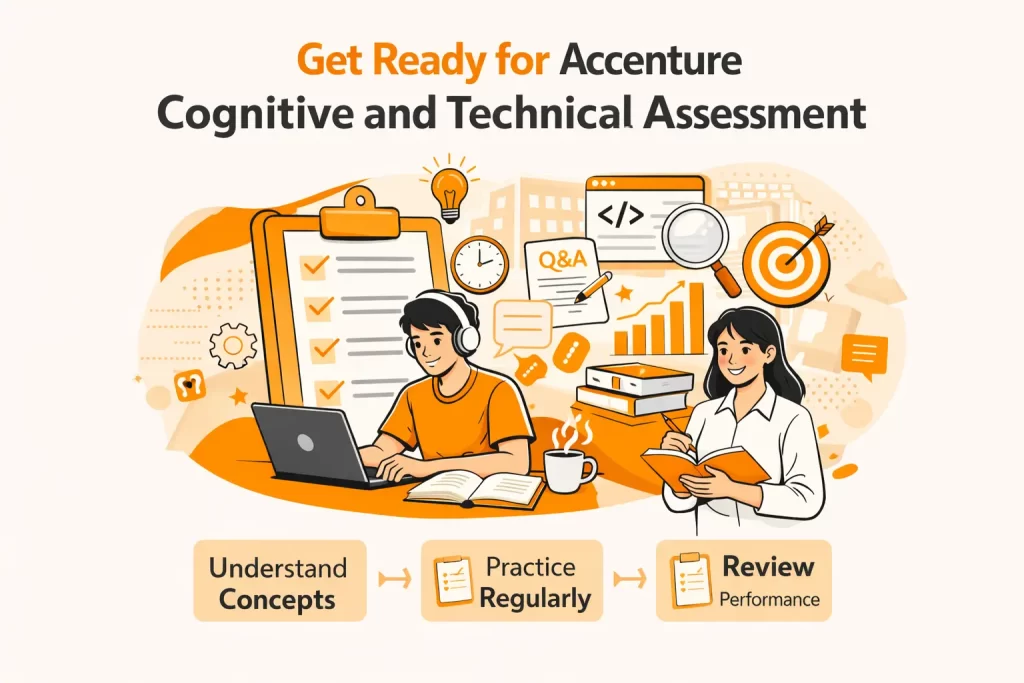
Preparing for the Accenture assessment requires a clear plan and regular practice. Candidates should focus on understanding basic concepts instead of memorizing answers. The assessment checks thinking ability, problem-solving skills, and basic technical knowledge, so preparation should be balanced across all sections.
Start by understanding the exam pattern and syllabus. Knowing what topics are included helps avoid wasting time on unnecessary areas. Divide your preparation time between cognitive assessment, aptitude, and technical topics. Consistent daily practice is more effective than studying everything at the last moment.
Mock tests should be used after completing basic preparation. They help candidates understand time pressure and improve accuracy. After each mock test, review mistakes carefully and work on weak areas. This step is often skipped but is very important for improvement.
Preparation Strategy for Cognitive and Technical Assessment
For the cognitive section, focus on logical thinking and understanding questions clearly. Read each question carefully before answering. Practice reasoning and aptitude questions regularly to improve speed and accuracy. Simple daily practice builds confidence over time.
For the technical section, revise basic programming concepts such as variables, conditions, loops, and logic flow. Understanding how code works is more important than remembering syntax. Practice explaining your approach, as this helps during both the assessment and interview.
Create a simple study schedule and follow it consistently. Short, focused study sessions are more effective than long and irregular ones. Keep enough time for revision before the exam.
Common Mistakes to Avoid in Accenture Exam
One common mistake candidates make is rushing through questions without reading them properly. This leads to avoidable errors, especially in aptitude and reasoning sections. Always take a few seconds to understand the question.
Another mistake is ignoring mock tests or not reviewing mock test results. Without reviewing mistakes, improvement becomes difficult. Candidates should also avoid relying only on previous questions, as the exam may change slightly each year.
Lastly, many candidates feel nervous during the exam. Staying calm and confident helps in thinking clearly and managing time better. Proper preparation reduces stress and improves overall performance.
Frequently Asked Questions (FAQs) on Accenture Assessment
Is the Accenture assessment difficult?
The difficulty level of the Accenture assessment is usually moderate. Most questions are based on basic aptitude, logical reasoning, and fundamental technical concepts. With regular practice, the test can be managed comfortably.
What sections are included in the Accenture assessment test?
The assessment generally includes cognitive ability, aptitude, verbal ability, and technical assessment. The exact sections may change slightly depending on the recruitment drive and role.
Is coding mandatory in the Accenture assessment?
Coding questions are included for technical roles, but they are mostly based on basic logic and problem understanding. Advanced coding knowledge is not always required.
Can previous year questions help in preparation?
Yes, reviewing previous Accenture assessment patterns helps candidates understand the type of questions asked and the exam structure. However, candidates should focus more on concepts rather than memorizing answers.
How many times can a candidate attempt the Accenture exam?
The number of attempts depends on Accenture’s recruitment policy at the time of hiring. Usually, candidates need to wait for a specific period before reapplying.
Are mock tests useful for Accenture preparation?
Mock tests are very useful. They help candidates manage time, understand exam pressure, and identify weak areas before the actual exam.
Is there a cut-off score in the Accenture assessment?
Accenture usually follows an internal cut-off, which may vary based on role, year, and number of candidates. Clearing the cut-off is necessary to move to the interview stage.
Final Thoughts
Preparing for Accenture cognitive and technical assessment questions requires the right approach, consistent practice, and clear understanding of basics. Instead of memorizing answers, candidates should focus on building strong aptitude, reasoning, and technical fundamentals. This makes it easier to handle both the online assessment and interview rounds confidently.
Using reliable guidance and structured learning support can make a big difference in preparation. Payilagam, the best software training institute in Chennai, helps students and job seekers by providing focused training, practice support, and guidance aligned with current industry requirements. With the right preparation strategy and regular effort, candidates can improve their chances of success in the Accenture recruitment process.
Start early, practice smartly, analyze mistakes, and stay confident. With proper preparation and the right support, clearing the Accenture assessment becomes an achievable goal.