Introduction
Before going into the concept of Types of Hashing Functions, do you think how information can be found within seconds in websites, applications or databases even when there are massive amounts of data involved? The scanning of every single record would definitely be time-consuming. With the increase in massive data, fast data storage and access become even more crucial today. This is one of the major problems in computing.
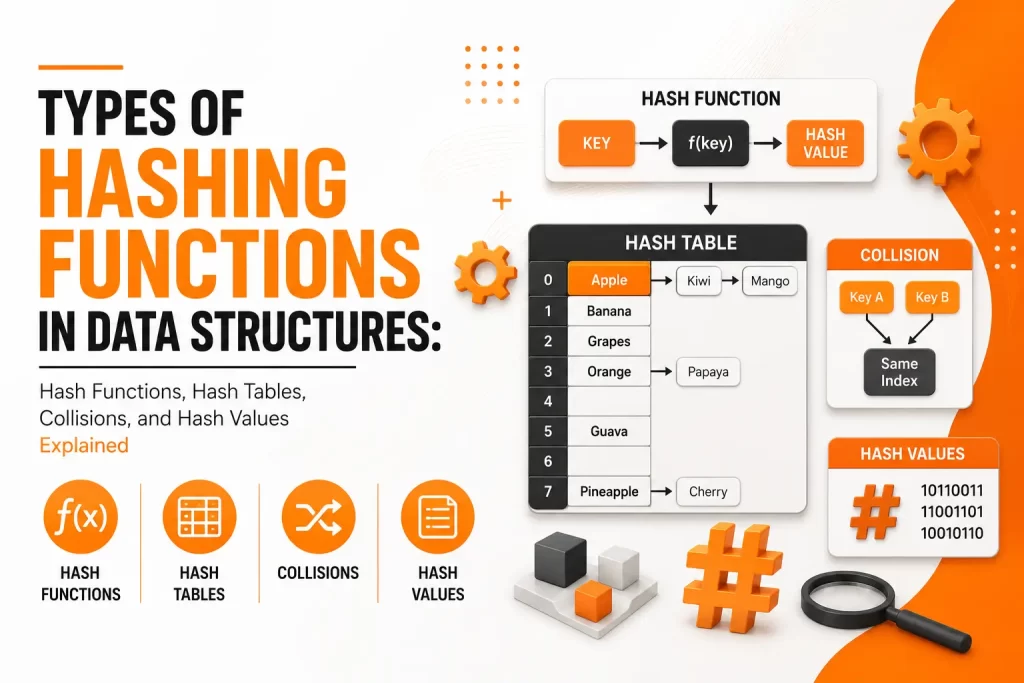
The answer to the above question is hashing. Hashing refers to the technique employed to help store and access the data fast without scanning every single record. Hashing aids in efficient data retrieval and helps reduce the search time. Hashing is used in some types of data structures like hash tables. Hashing involves a mathematical function which is referred to as hash function. The hash function maps the data to a hash value (also called hash code or hash).
In this blog post, you will get to know all about Hashing in Data Structures, Hash Function in Data Structure, Types of Hashing, Collision in Hashing, Hash Functions, and the types of hash functions. If you wish to build a strong foundation on Data Structures such as Hash Tables and programming, then Payilagam is the right place for you to learn easily.
What Is Hashing in Data Structures?
Hashing is one of the methods that aid the computer in organizing data to make it easy to find later. Instead of looking for the data in the whole set, the computer uses some means of calculating where it will put it.
In plain English, hashing in data structure refers to the process that takes input and makes it into some hash of fixed size. It is termed a hash value, hash code, or hash value or hash code.
Various contemporary applications employ the technique of hash algorithm due to its efficiency in storing information. If one needs to find a username, look for an item in an online shop, or organize the files in a database, hash algorithm is applied.
What Is a Hash Function in Data Structure?
Hash function in data structure is a mapping procedure which translates data into numeric data. This numeric data is referred to as a hash, hash value or hash code. Hash function is used in determining the location at which the data will be stored within the hash table.
Hash function is a mathematical function which translates any given data into a value of fixed size. This value is eventually used as index in the hash table.
For instance, in case a student roll number is to be stored, the computer system uses the hash function to determine the hash value and thus store it at the right index in the hash table.
The hash function needs to distribute values uniformly throughout the table. The hash function must not create a situation in which the same hash value is created by two different keys or keys hashing to the same index.
How Does a Hash Function Produce a Hash Value?
- ☑️ Every data hash function undergoes the same basic procedure.
- ☑️ It takes input data.
- ☑️ It carries out some mathematical computation.
- ☑️ It produces a fixed-size hash.
- ☑️ The output is known as a hash value or hash code.
- ☑️ The produced output acts as an index into the hash table.
Let us consider a classroom where each student is allotted a locker number according to their roll number. This saves time as one doesn’t have to search for each and every locker. Similarly, a hash function works by computing the correct place to store data.
The efficiency of storing and retrieving data depends on how well the hash function disperses the values.
Why Is Hashing Used in Data Structures?
The major aim of using hashing in data structures is that it helps in improving data retrieval.
This is because;
- ☑️ It makes searching faster than many other data structures.
- ☑️ Insertion and deletion of records is fast.
- ☑️ Better data storage.
- ☑️ Mapping data to storage easily.
- ☑️ Effective use of large data sets.
- ☑️ It is commonly used in data structures.
For all these benefits, programmers tend to use hash tables when they want quick access to information.
Types of Hashing Function in Data Structure
Various applications use various methods of hashing. Selection of the appropriate hash function is based on the nature of data, size of table, and number of records.
The following are the major hash functions used in computer science.
☑️ Division Method
Division method is among the easiest hashing methods.
The formula is given by:
Hash value = Key mod Table Size
- ☑️ The resulting remainder will be the hash value and hence will be used as an index in the hash table.
- ☑️ The division method gives good results if the table size is wisely selected. Use of a prime number in the table size will minimize hash collisions.
Multiplication Method
- ☑️ The Multiplication Method involves multiplying the key with a decimal constant. Once this multiplication is done, only a particular portion of the multiplied value is used in calculating the hash function.
- ☑️ This method usually provides a good distribution of values and prevents clustering in the hash table.
Mid-Square Method
- ☑️ The Mid-Square Technique involves squaring of the key input initially.
- ☑️ Once the square has been done, the middle numbers are chosen to form the hash code.
- ☑️ Since the middle numbers tend to vary more than the starting and ending numbers, this technique yields good distribution results.
Folding Method
- ☑️ For the Folding Method, the process involves breaking the key into smaller sections of equal size.
- ☑️ These sections are then summed up to form the hash value.
- ☑️ This method is particularly helpful when dealing with long keys since it makes the computation easier without affecting its efficiency.
Digit Extraction Method
- ☑️ The Digit Extraction Technique involves choosing particular digits from the input key.
- ☑️ These particular digits are then used to create the hash code.
- ☑️ Though easy, this technique is recommended to use only if the chosen digits are uniformly distributed among all possible values.
Universal Hashing
- ☑️ Universal Hashing is a technique wherein one hashing algorithm is chosen from among many algorithms.
- ☑️ In other words, instead of using the same algorithm repeatedly, the process chooses any algorithm randomly. The technique makes sure that the probability of having collisions is minimized.
- ☑️ This technique offers improved performance and security in the case of large-scale data applications.
What Is a Hash Table and How Does It Work?
Hash Table is one of the most frequently utilized data structures owing to its ability to provide quick storage and retrieving data. Hash tables store data in arrays, where every index has its unique number. Unlike the process of searching every piece of data separately, the hash table uses the hash function to identify the right place for data storing.
The primary reason for using hash table as a data structure is the improved efficiency in data retrieval. The data is entered into the computer as an input, where hash functions convert this data to a certain hash value. This hash value or hash code serves as an index in the hash table.
As long as the distribution of values is even using hash function in data structure, operations of searching, insertion, and deletion of data become more efficient. This is the reason for the frequent usage of such data structures in databases, search engines, operating systems, and other software programs.
Components of a Hash Table
- ☑️ There are a number of important components that make up a hash table.
- ☑️ Input Data: The data that has to be stored.
- ☑️ Hash Function: A mathematical formula that changes the input into a set size output.
- ☑️ Hash Value: The output produced by the formula, which is also referred to as a hash value, hash code or a hash.
- ☑️ Index of the Hash Table: Where the data is to be stored.
- ☑️ Slot in the Hash Table: The memory location where the data is actually stored.
- ☑️ This helps in organizing data so that retrieving data is an easy task.
How Keys Are Stored Using a Hash Function?
Now suppose that we wish to insert the student record using Student ID 101.
Here the computer uses the hash function to compute the hash value. Assuming that the size of the table is 10, the hash function can operate as follows:
101 % 10 = 1
The result comes out to be 1, which is now used as the index of the hash table.
The student’s record will be inserted in index 1. In case, at a later time, we are searching for Student ID 101, then again using the same hash function we get the same hash value. Thus, the record can be easily found.
Advantages of Using a Hash Table
- ☑️ A hash table has many advantages.
- ☑️ Allows for efficient retrieval of data.
- ☑️ Performs quick searches, insertions, and deletions.
- ☑️ Works well with large amounts of data.
- ☑️ Decreases the time taken for data storage and retrieval.
- ☑️ Commonly employed in data structures in real-time applications.
- ☑️ Maps data to a storage position directly.
- ☑️ Allows efficient hashing techniques.
- ☑️ For this reason, data structures such as hash tables are one of the most popular subjects in computer science.
What Is a Hash Collision?
Hash collision occurs in a situation where two keys generate the same hash key value. In this case, since two keys generate the same index value in the hash table, there will be a conflict for the slot position that they are trying to fit into.
It is quite normal for collisions to occur in hashing because there are more input values compared to slot positions.
Collisions can be resolved by employing various collision resolution techniques.
Why Does a Hash Collision Occur?
- ☑️ There are many causes of hash collision.
- ☑️ The table size of the hash is too small.
- ☑️ The hash function used is not appropriate.
- ☑️ A lot of input data makes a collision more likely.
- ☑️ There is more than one value that hashes to the same index.
In case the size of the hash is 10, then both keys 25 and 35 give:
25 % 10 = 5
35 % 10 = 5
Both the keys compete for the same slot, hence the hash collision.
When Two Keys Produce the Same Hash Value
- ☑️ Let us consider a scenario where books in a library are placed in the racks according to the last digit of their book numbers.
- ☑️ Book Number 126 will be kept in Shelf 6.
- ☑️ Book Number 236 will also be kept in Shelf 6.
- ☑️ Though the two books are different from each other, they end up being in the same rack.
- ☑️ Similarly, in a hash table, when two keys result in the same hash value, it becomes necessary for the program to handle both the records.
- ☑️ This is known as collision resolution.
Real-World Examples of Hash Collision
- ☑️ Hash collisions may take place in numerous practical applications.
- ☑️ Systems managing user accounts.
- ☑️ Product databases on websites for e-commerce.
- ☑️ Search engines.
- ☑️ Banking applications.
- ☑️ Student record management systems.
- ☑️ Library management applications.
- ☑️ In all such applications, the system is required to hold millions of records in addition to providing efficient data retrieval.
Collision Resolution Techniques in Hashing
As not all collisions can be prevented, various types of hashing are applied to deal with them. They guarantee that all records will be stored properly, regardless of whether several keys have produced the same hash values.
The most popular collision resolution strategies are discussed below.
Separate Chaining Using a Linked List
Separate Chaining allows for more than one record to be stored at the same location through chaining.
Each cell in the hash table has a linked list. Each time another record ends up being hashed to the same index, it is just appended to the linked list.
For instance,
Index 5
→ Student A
→ Student B
→ Student C
Despite the fact that the three records end up having the same hash value, each record will be stored properly.
Separate Chaining is quite easy to implement and is efficient in cases where there aren’t too many collisions.
Linear Probing
Linear probing is perhaps one of the most commonly used forms of open addressing schemes.
Rather than forming a chain, the algorithm looks for the next available slot.
For instance,
Let us assume that slot 4 is already taken.
In such a case, the algorithm will check:
Slot 5
Slot 6
Slot 7
till it finds an empty slot.
Although linear probing is simple to use, it can sometimes form a cluster of items together.
Quadratic Probing
Quadratic probing is yet another form of open addressing.
In this technique, positions aren’t checked sequentially, but through jumping using squared numbers.
Here is how the sequence looks like:
+1²
+2²
+3²
+4²
Unlike linear probing, this technique makes sure that records are spread out uniformly and prevents clustering in the hash table.
Double Hashing
Double hashing is among the most successful collision resolution strategies.
Unlike other approaches, where a single function is used, in double hashing, another function is applied when collision arises.
In double hashing, the first function determines the primary position.
If the position is found to be occupied, then the second function computes another position.
Since two computations are done, the technique greatly decreases hash collisions and increases efficiency of the hash table.
It is among the best collision resolving strategy because records in the hash table are distributed evenly.
Properties of a Good Hash Function
Hash function is considered a crucial factor in the efficiency of hash table. No matter how efficient the hashing algorithm may be, it will never work effectively if the function leads to lots of collisions. It is necessary to provide even distribution of elements to maintain the speed of searching, insertion, and deletion of records.
A properly created hash function of the data structure must produce a unique hash for the different data set as often as possible. It is impossible to guarantee that there won’t be any hash collision; however, a proper function will minimize the probability of collision of two keys.
Let us consider the features of hash functions.
Uniform Distribution of Hash Values
First and foremost, a hash function should be one that gives rise to uniform distribution.
It should distribute the data in such a way that the data ends up being uniformly spread out within all the available slots in the hash table and not many end up in the same slot. With uniform distribution, hash collision probability becomes very low.
It also makes the efficient retrieval of data easy.
Fast Computation
Also, the hash function must be fast.
The mathematical computation must be performed very fast to ensure that the hash value is calculated fast for each and every new data record.
This is because the application might process thousands and millions of records within seconds.
Reducing Hash Collision
Another significant property is decreasing collisions.
Ideally, a hash function should assign a unique hash code to each distinct record. In case there are too many collisions, the performance drops due to the amount of time spent on collision resolution.
In order to provide efficient data retrieving for users, collisions have to be minimized.
Choosing a Good Hash Function
Selection of the proper hash function will depend on the use case.
As part of selection of a good hash function, one needs to take into consideration the following factors:
Size of the hash table.
Type of the data to be hashed.
Number of records expected.
Presence of collisions.
Speed requirement for storage and access.
In more advanced uses cases, universal hashing is usually used.
Applications of Hashing in Data Structures
The applications of hashing in data structures are numerous in the real world. Since it gives efficient ways to store and retrieve data, it has turned out to be one of the most significant topics in computer science.
Database Indexing
There are millions of records stored in databases.
With the use of the hash table, the process of locating a record becomes easy without having to look through the whole database.
Password Storage
In contemporary implementations, passwords are not stored in plaintext format.
The implementation is done using password hashing that uses cryptographic hash functions to generate a fixed-length hash for a password.
The actual password becomes difficult to recover even if the database gets accessed by an unauthorized user.
Caching Systems
Speed can be increased by using cache within web browsers, mobile apps, and operating systems.
The hash table is useful when locating the stored data and making its access faster.
This way, performance will be increased.
Compiler Symbol Tables
Hash tables are used by programming language compilers for managing variables, functions, and symbols.
Rather than searching through all the symbols, the compiler uses a hash function to directly find the necessary information.
Difference Between Hashing and Other Data Structures
Even though hashing in data structures is widely used, it is necessary to know how it differs from other data structures.
Hash Table vs Array
- ☑️ The array stores the items at consecutive locations.
- ☑️ Search operations for an item could take multiple locations to be accessed.
- ☑️ In the hash table, on the other hand, the search can take place directly by using the hash function to find the index of the required record in the hash table.
Hash Table vs Linked List
- ☑️ In a linked list, each element is connected to the next using links.
- ☑️ Locating a specific record would mean going through many nodes.
- ☑️ In a hash table, a hash function is used to determine the location, hence faster access.
- ☑️ Linked lists are, however, valuable in Separate Chaining, which is one of the popular collision resolution techniques.
When to Choose Hashing
Go for hashing when your application needs:
- ☑️ Fast search.
- ☑️ Fast insertion and deletion.
- ☑️ Fast data access.
- ☑️ Processing huge volumes of data.
- ☑️ Better performance in data storage and access.
And that is why hash tables and other data structures are extensively used in software applications today.
Common Mistakes to Avoid When Implementing Hashing
Though simple enough to comprehend, a lot of learners make blunders that affect efficiency.
Selecting a Poor Hash Function
- ☑️ An inefficient hash function will lead to frequent collisions.
- ☑️ Uneven distribution of records leads to inefficient searches.
- ☑️ Select an efficient hash function whose values are distributed evenly.
Ignoring Collision Resolution
- ☑️ Many beginners think that no collisions would ever occur.
- ☑️ However, collision handling is an integral aspect of each implementation of hash tables.
- ☑️ Techniques such as linear probing, quadratic probing, double hashing, and Separate Chaining must always be taken into account.
Using an Inefficient Algorithm
- ☑️ Choosing a low efficiency algorithm will take longer to execute.
- ☑️ Always choose those hashing methods that work well with your program, table size, and amount of data.
Frequently Asked Questions
What is hashing in data structures?
Hashing is a process of storing and retrieving data in an efficient way using a hash value, which identifies the data’s location in the hash table.
What is a hash function in data structure?
In the data structure, hash function is a mathematical function which takes some data and then produces an output value which is referred to as the hash code or hash value.
What are the different types of hash functions?
The common types of hash functions are Division Method, Multiplication Method, Mid-Square Method, Folding Method, Digit Extraction Method and Universal Hashing.
What is a hash table?
The hash table is a data structure that uses hashing values for storing the data such that it can be searched, inserted, or deleted easily.
What is a hash collision?
Hash collision takes place if two keys have same hash value or same index.
How does collision resolution work?
Collisions can be handled through techniques like Separate Chaining, Linear Probing, Quadratic Probing, and Double Hashing.
Why is a linked list used in separate chaining?
The use of the linked list structure means that multiple records can be stored in the same slot of the hash table in case of collisions.
What are the properties of a good hash function?
Uniformity, speed, efficiency, and minimum collision are key attributes for any good hash function.
Where are hashing algorithms used?
There are a number of different hashing algorithms, and these have uses in databases, storing passwords, caching, search engines, compiling symbols and many other computer science problems.
Why do two keys produce the same hash value?
This occurs due to the fact that the number of available slots in a hash table is fixed. There can be different inputs that produce the same hash value, resulting in hash collision.
Final Thoughts
Hashing in Data Structures is an important concept for all those who are learning programming and computer science. Hash Function produces a unique hash value from the input data. Using hash tables, one can insert or retrieve data from it very quickly despite the occurrence of hash collisions.
With knowledge of the kinds of hashing, kinds of hash functions, and characteristics of a good hash function, you can develop applications that provide fast data storage and retrieval, efficiency, and data integrity. The ideas are extensively applied in data structures and lay the basis for numerous software systems.
If you would like to learn data structures such as hash tables, algorithms, and other programming concepts by applying the practice approach, Payilagam, the best software training institute in Chennai, provides industry-oriented Java Training in Chennai for both beginners and future software professionals. Developing skills in hashing now will be beneficial in solving your programming issues in the future.