Introduction
A tricky situation during a Selenium interview is when the interviewer asks, “Can you explain your automation framework?” Many candidates are adept in using Selenium WebDriver, TestNG, and automation scripts, but even these candidates have difficulty in verbally expressing their framework. Some candidates start giving textbook definitions, while others jump into coding concepts without explaining the actual framework architecture or the execution flow. Because of this, even the best automation testers have difficulty in making a positive impression during their interviews.
The primary reason interviewers have questions regarding the framework is not to test the candidate’s knowledge regarding the tools. The interviewers wish to ascertain whether the candidate has practical automation testing experience, has an understanding of the framework and its components, knows the execution flow, and is able to describe the automation scripts and test cases in their actual work projects. The interviewers are also expecting the candidates to coherently and confidently describe Selenium WebDriver, Java, TestNG, Maven, Jenkins, Git, reporting tools, and Page Object Model. This is where most of the freshers and automation engineers with less than 5 years of experience are confused during an interview.
The good thing is that if you follow a specific structure, describing a Selenium automation framework is pretty easy. Once you understand how to approach the explanation of framework type, architecture, execution flow, reusable components, reporting, CI/CD integration, and how you’ve used this in projects, you can answer practically any Selenium automation framework interview question with a great deal of confidence. In this blog, we will learn how to describe the framework in Selenium during interviews by using practical examples, real framework descriptions, execution flow breakdowns, and templated interview responses for both freshers and seasoned testers.
What Is a Framework in Selenium?
A Selenium framework is an organized method for writing automation scripts, reusable parts, test data, reports, execution order, and project tools, making automation testing more rapid, simple, and manageable. Instead of writing random Selenium WebDriver scripts for every test case, companies use automation frameworks for organized management of the testing process.
For an actual project, a Selenium automation framework allows testers to write less redundant code, improve test execution, handle large volumes of test cases, and make maintenance easier when changes to the application are made. This is the reason almost every organization has a test automation framework for web application testing.
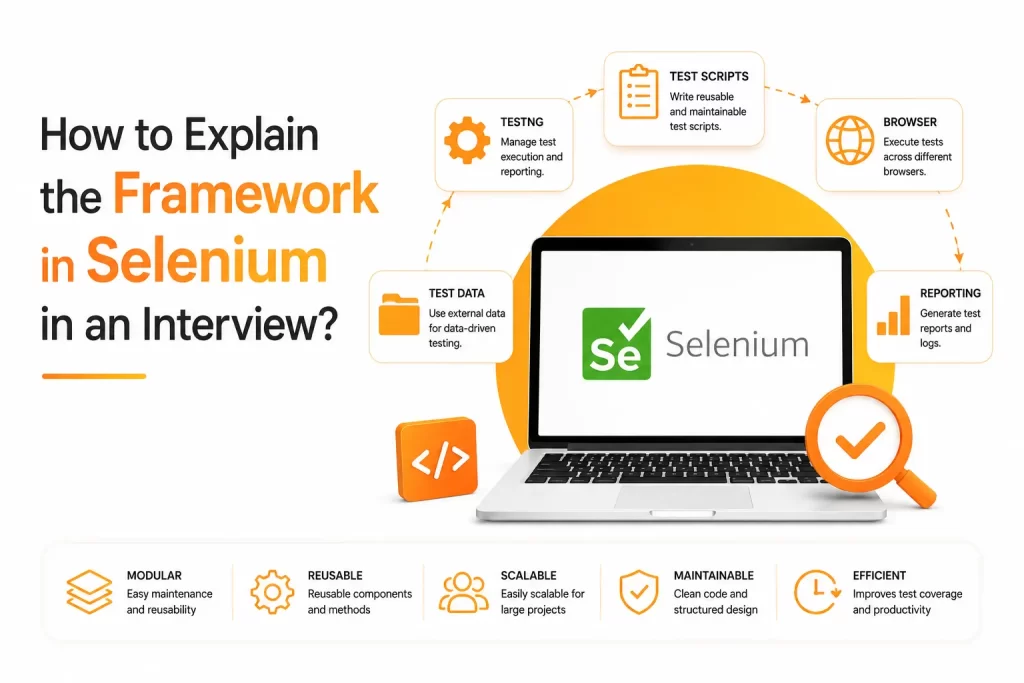
An automation framework integrates many components: Selenium WebDriver, TestNG, Maven, Page Object Model, reporting tools, utility classes, and test data management. These components of the framework help automation teams efficiently carry out test execution and enhance productivity of testing.
- ✅ A Selenium framework can help you create organized automation scripts.
- ✅ Automation scripts become easier to manage and reuse across multiple tests when frameworks are used.
- ✅ Selenium WebDriver is a tool for automating browsers and testing web applications.
- ✅ Page Object Model allows you to keep your locators separated from your reusable methods and page actions.
- ✅ TestNG does your test executions and also handles assertions, grouping, and running tests in parallel.
- ✅ Maven is a tool used to manage the dependencies of a project and the build execution.
- ✅ Frameworks increase the maintainability of a project in cases where the application changes.
- ✅ Utility classes are helpful for screenshot captures, running script delays, logging, and setup of functions across multiple classes.
- ✅ Test data can be managed in Excel, JSON files, or a database.
- ✅ After your tests run, reports can be generated with the use of reporting tools.
- ✅ Frameworks can be scaled for your needs to manage extensive automation projects.
- ✅ If you want to achieve CI/CD and have your test runs scheduled, Jenkins is a common tool used for this.
- ✅ For managing versions and collaboration for automation projects, Git is used.
- ✅ Test failures can be managed with the use of explicit waits, which make tests run more in sync.
- ✅ The framework architecture helps to keep your folders, scripts, utilities, reports, and configurations organized.
- ✅ A well-built automation framework will help you with test executions and manage your time better.
- ✅ For teams needing to create an enterprise application automation solution, the use of Selenium frameworks is appropriate.
- ✅ When testing is implemented in a framework, it becomes a lot simpler to debug and maintain.
- ✅ For real-time automation projects, a framework is the best solution.
Why Interviewers Ask About Selenium Frameworks
Many candidates think interviewers ask framework questions only to check Selenium knowledge. In reality, the question helps them understand whether the candidate has worked on real automation projects or has only learned Selenium concepts theoretically. Framework-related discussions often reveal how much practical experience a tester has with automation development, project structure, execution flow, and problem-solving.
For freshers, interviewers want to know whether they understand the basics of a test automation framework. For experienced professionals, they expect deeper knowledge about framework architecture, maintainability, scalability, CI/CD integration, reporting, and reusable components. This is why framework questions are considered one of the most important parts of Selenium automation interviews.
Key Points
- ✅ Helps interviewers evaluate real-time automation testing experience
- ✅ Shows whether the candidate has worked on actual automation projects
- ✅ Tests understanding of Selenium framework architecture
- ✅ Evaluates knowledge of framework components and their purpose
- ✅ Helps identify the candidate’s contribution to framework development
- ✅ Measures understanding of automation script organization
- ✅ Checks knowledge of Page Object Model and reusable components
- ✅ Tests understanding of test data management techniques
- ✅ Evaluates knowledge of TestNG, Maven, Jenkins, and Git integration
- ✅ Helps assess problem-solving ability in automation projects
- ✅ Checks whether the candidate understands execution flow clearly
- ✅ Evaluates framework maintainability and scalability knowledge
- ✅ Helps determine how candidates handle framework challenges in projects
- ✅ Measures confidence in explaining technical concepts during interviews
- ✅ Identifies whether the candidate can explain automation testing experience practically
- ✅ Helps interviewers differentiate between theoretical knowledge and hands-on experience
- ✅ Reveals understanding of reporting, logging, and debugging mechanisms
- ✅ Tests knowledge of CI/CD implementation in automation frameworks
- ✅ Evaluates overall ownership and involvement in automation framework activities
Understanding why interviewers ask these questions makes it easier to prepare the right answer. The next step is learning the exact structure used by successful automation testers to explain their Selenium framework confidently during interviews.
One of the biggest mistakes candidates make during interviews is explaining framework components randomly. They start with Selenium WebDriver, then jump to TestNG, and later discuss Jenkins or reporting. This approach often confuses interviewers because they cannot understand the overall framework structure.
A better approach is to explain the framework in a proper flow. Most experienced automation engineers follow a structured explanation that starts from framework type and gradually moves toward architecture, execution flow, reporting, and CI/CD integration. This makes the explanation easier to understand and creates a professional impression during interviews.
1. Start With Framework Type
Before explaining any technical details, always tell the interviewer what type of framework you worked on.
- ✅ Mention whether it is a Hybrid Framework, Data-Driven Framework, BDD Framework, or POM Framework
- ✅ Explain why the framework was selected for the project
- ✅ Describe the advantages of that framework type
- ✅ Mention how the framework improves maintainability and scalability
- ✅ Explain how reusable components are used within the framework
- ✅ If it is a Hybrid Framework, explain the combination of POM, Data-Driven Testing, and TestNG
- ✅ If it is a BDD Framework, mention Cucumber and Gherkin syntax
2. Mention Tech Stack
After explaining the framework type, describe the technologies used in the framework.
- ✅ Java for automation script development
- ✅ Selenium WebDriver for browser automation
- ✅ TestNG for test execution and reporting
- ✅ Maven for dependency management
- ✅ Jenkins for CI/CD execution
- ✅ Git for version control and collaboration
- ✅ Log4j for logging and debugging
- ✅ Extent Reports for detailed execution reports
- ✅ Apache POI for Excel data handling
- ✅ Cucumber for BDD implementations
3. Explain Framework Architecture
Once the interviewer understands the framework type and tools used, explain the framework architecture.
- ✅ Explain the folder structure clearly
- ✅ Describe the purpose of Base Class
- ✅ Explain Page Object Model implementation
- ✅ Mention utility classes and reusable functions
- ✅ Explain where test data is stored
- ✅ Describe configuration file management
- ✅ Explain report generation modules
- ✅ Discuss listener implementation if used
- ✅ Explain how object repositories are maintained
4. Explain Execution Flow
Execution flow is one of the most important areas interviewers focus on.
- ✅ Explain how TestNG XML starts execution
- ✅ Describe how the Base Class initializes WebDriver
- ✅ Explain how test classes invoke page methods
- ✅ Describe interaction between page classes and locators
- ✅ Explain how utility methods support execution
- ✅ Discuss screenshot capture during failures
- ✅ Explain report generation process
- ✅ Describe how failed test cases are handled
- ✅ Mention parallel execution if implemented
5. Explain Reporting and CI/CD
Finally, explain how reporting and continuous integration are implemented within the framework.
- ✅ Explain Extent Report generation
- ✅ Discuss screenshot attachment in reports
- ✅ Describe Jenkins job configuration
- ✅ Explain scheduled execution process
- ✅ Mention Git integration with Jenkins
- ✅ Explain CI/CD workflow
- ✅ Discuss email report generation
- ✅ Explain automation execution after code commits
- ✅ Highlight business benefits of continuous testing
Following this structured approach makes framework explanations much easier and helps candidates answer Selenium automation framework interview questions with confidence. The next section will provide ready-to-use sample answers that can be directly used in interviews by both freshers and experienced automation testers.
Sample Answer to Explain the Selenium Framework in an Interview
When answering this question in an interview, avoid giving a lengthy explanation immediately. Start with a short overview of your framework, then explain the technologies used, framework architecture, execution flow, and reporting process. A good answer should sound practical and project-oriented rather than theoretical. The goal is to show that you understand how the framework works from end to end and how it helps improve automation efficiency, maintainability, scalability, and test execution management in real-time projects.
I worked on a Hybrid Selenium Automation Framework developed using Java, Selenium WebDriver, TestNG, and Maven. We followed the Page Object Model design pattern to separate locators and reusable methods from test scripts, which improved maintainability. Test data was managed through Excel files using Apache POI, and TestNG was used for test execution, assertions, grouping, and parallel execution. Maven handled dependency management, while Extent Reports generated detailed execution reports with screenshots. We used Git for version control and Jenkins for CI/CD execution. This framework helped us reduce code duplication, improve reusability, and execute automation tests efficiently across different environments.
Components of Selenium Automation Framework
A Selenium automation framework is made up of multiple components that work together to create a structured, maintainable, and scalable automation solution. During interviews, simply naming these components is not enough. You should also explain the purpose of each component and how it contributes to the overall framework architecture. Understanding these framework components shows interviewers that you have practical automation testing experience and real project exposure.
Page Object Model (POM)
- ✅ Separates locators and page methods from test scripts
- ✅ Improves code reusability and maintainability
- ✅ Each application page has its own page class
- ✅ Stores web element locators in a centralized location
- ✅ Reduces script maintenance when UI changes occur
- ✅ Makes automation scripts cleaner and easier to understand
- ✅ Supports scalable framework development
Base Class
- ✅ Initializes Selenium WebDriver
- ✅ Handles browser setup and configuration
- ✅ Manages implicit and explicit waits
- ✅ Contains reusable common methods
- ✅ Loads configuration files and environment settings
- ✅ Supports browser launch and browser closure activities
- ✅ Acts as the foundation of framework execution
Utility Classes
- ✅ Handles screenshot capture during failures
- ✅ Manages Excel file reading and writing operations
- ✅ Implements retry mechanisms for failed tests
- ✅ Contains generic reusable functions
- ✅ Supports logging and debugging activities
- ✅ Reduces code duplication across projects
- ✅ Improves framework maintainability
TestNG Framework
- ✅ Controls test execution flow
- ✅ Supports annotations such as BeforeSuite and AfterSuite
- ✅ Provides assertions for validation
- ✅ Enables test grouping and prioritization
- ✅ Supports parallel execution
- ✅ Uses DataProvider for data-driven testing
- ✅ Generates execution reports after test runs
Maven
- ✅ Manages project dependencies automatically
- ✅ Uses pom.xml for dependency configuration
- ✅ Simplifies build and execution processes
- ✅ Reduces manual JAR file management
- ✅ Supports framework scalability
- ✅ Helps maintain project consistency across environments
- ✅ Integrates easily with CI/CD tools
Jenkins
- ✅ Enables CI/CD implementation
- ✅ Supports scheduled test execution
- ✅ Automates test execution after code changes
- ✅ Generates execution reports automatically
- ✅ Integrates with Git repositories
- ✅ Reduces manual testing effort
- ✅ Improves continuous testing processes
Git
- ✅ Provides version control for automation projects
- ✅ Tracks code changes effectively
- ✅ Supports branching and merging strategies
- ✅ Helps multiple team members collaborate
- ✅ Maintains project history and backups
- ✅ Integrates with Jenkins for CI/CD workflows
- ✅ Simplifies automation project management
Together, these framework components form the backbone of a Selenium automation framework and are commonly discussed in Selenium automation framework interview questions and answers. Understanding their purpose and interaction helps candidates explain their framework confidently during interviews.
Execution Flow of the Hybrid Framework in Selenium
| Step | Execution Flow | Purpose |
| 1 | TestNG XML Triggers Execution | Starts the automation execution process based on configured test suites |
| 2 | Base Class Initializes WebDriver | Launches the browser and loads environment configurations |
| 3 | Configuration File Is Loaded | Reads application URL, browser type, credentials, and environment details |
| 4 | Test Class Starts Execution | Executes the selected test cases based on TestNG configuration |
| 5 | Page Class Methods Are Invoked | Calls reusable methods available in Page Object Model classes |
| 6 | Selenium WebDriver Interacts with Elements | Performs actions such as click, sendKeys, select, and validations |
| 7 | Utility Classes Handle Reusable Functions | Manages waits, screenshots, logging, Excel operations, and generic methods |
| 8 | Test Data Is Retrieved | Fetches data from Excel, JSON, database, or DataProvider sources |
| 9 | Assertions Validate Results | Compares expected and actual results using TestNG assertions |
| 10 | Screenshot Captured on Failure | Stores evidence for failed test cases |
| 11 | Extent Report Generates Results | Creates detailed execution reports with pass/fail status |
| 12 | TestNG Produces Execution Summary | Displays execution statistics and test results |
| 13 | Jenkins Triggers CI/CD Execution | Executes automation as part of scheduled or continuous integration jobs |
| 14 | Email Notifications Sent | Shares execution reports with stakeholders automatically |
| 15 | Browser Closes and Execution Ends | Cleans up resources and completes the test execution cycle |
How to Explain a Data-Driven Framework in Selenium in an Interview?
- ✅ Data-Driven Framework separates test data from automation scripts
- ✅ Test data is stored in external sources such as Excel files, JSON files, CSV files, or databases
- ✅ The same automation script can execute multiple test cases using different data sets
- ✅ Reduces duplicate test scripts and improves reusability
- ✅ Makes test maintenance easier when test data changes
- ✅ Supports large-scale test execution efficiently
- ✅ TestNG DataProvider is commonly used for parameterization
- ✅ Apache POI is frequently used for reading Excel data
- ✅ Test data management becomes centralized and organized
- ✅ Improves framework maintainability and scalability
- ✅ Helps achieve better test coverage with minimal code changes
- ✅ Supports positive and negative test scenarios using different data combinations
- ✅ Reduces manual effort in creating multiple automation scripts
- ✅ Commonly used in login testing, registration testing, form validation, and data verification scenarios
- ✅ Framework execution remains the same while only test data changes
- ✅ Enhances automation efficiency in real-time projects
Sample Interview Answer
- ✅ I worked on a Data-Driven Framework where test data was maintained externally in Excel files.
- ✅ Selenium WebDriver handled browser automation, while TestNG DataProvider supplied test data to scripts.
- ✅ Apache POI was used to read and write Excel data.
- ✅ The same automation script executed multiple test scenarios using different input values.
- ✅ This approach improved code reusability, simplified test data management, and reduced maintenance effort.
- ✅ It also helped execute large numbers of test cases without creating separate scripts for each scenario.
How to Explain the BDD Cucumber Framework in an Interview?
- ✅ BDD stands for Behavior Driven Development
- ✅ BDD Framework focuses on business-readable test scenarios
- ✅ Cucumber is the most commonly used tool for implementing BDD in Selenium
- ✅ Test scenarios are written in Gherkin language
- ✅ Gherkin syntax uses Given, When, Then, And, and But keywords
- ✅ Feature files contain business requirements and test scenarios
- ✅ Step Definition files contain automation code linked to feature file steps
- ✅ Runner Class controls test execution
- ✅ Selenium WebDriver performs browser automation
- ✅ TestNG or JUnit can be integrated for execution management
- ✅ Page Object Model is often used along with BDD Framework
- ✅ Reports are generated after execution using Cucumber Reports or Extent Reports
- ✅ Business analysts, testers, and developers can easily understand feature files
- ✅ Improves collaboration between technical and non-technical teams
- ✅ Makes automation scenarios more readable and maintainable
- ✅ Supports reusable step definitions across multiple test cases
- ✅ Reduces communication gaps between stakeholders and automation teams
- ✅ Widely used in Agile and Scrum projects
Sample Interview Answer
- ✅ I worked on a BDD Cucumber Framework developed using Java, Selenium WebDriver, Cucumber, TestNG, and Maven.
- ✅ Business scenarios were written in feature files using Gherkin syntax with Given, When, and Then statements.
- ✅ Step Definition files contained the automation code corresponding to each feature file step.
- ✅ Selenium WebDriver was used for browser interactions, while Page Object Model was implemented for better maintainability.
- ✅ Maven managed project dependencies, and Jenkins was used for CI/CD execution.
- ✅ Reports were generated using Cucumber Reports and Extent Reports after execution.
- ✅ This framework improved collaboration between business teams and automation teams because the test scenarios were easy to understand and maintain.
- ✅ It also helped create reusable automation scenarios and improved overall framework scalability.
Common Selenium Framework Interview Questions
- What is a framework in Selenium?
- What is a hybrid framework?
- Why do you use Page Object Model (POM)?
- What are generic functions in Selenium?
- How does your framework execution flow work?
- Where do you store locators in your framework?
- How do you manage test data in your automation framework?
- How is the retry mechanism implemented in Selenium?
- How do you integrate Jenkins with Selenium Framework?
- How do you handle screenshots in automation testing?
- How do you run failed test cases automatically?
- How do you achieve parallel execution in Selenium?
- What is the difference between POM and Data-Driven Framework?
- What is the difference between Hybrid Framework and BDD Framework?
- Why do we use TestNG in Selenium Framework?
- What is the role of Maven in an automation framework?
- How do you manage dependencies using Maven?
- What is the purpose of the Base Class in Selenium Framework?
- What are utility classes in an automation framework?
- How do you generate reports in Selenium Framework?
- What is Extent Report?
- How do you perform logging in Selenium Framework?
- What is the role of Git in automation testing?
- How does CI/CD work in Selenium automation?
- How do you handle dynamic web elements in your framework?
- How do you implement DataProvider in TestNG?
- What is Page Factory in Selenium?
- How do you maintain object repositories?
- What are listeners in TestNG?
- How do you perform cross-browser testing in your framework?
- How do you handle synchronization issues in Selenium?
- What are explicit waits and why are they used?
- How do you automate test execution using Jenkins?
- What framework challenges did you face in your project?
- How did you improve framework maintainability?
- How do you make your automation framework scalable?
- What is Selenium Grid and how is it used?
- How do you integrate API testing with Selenium Framework?
- How do you execute tests in parallel using TestNG?
- Explain your Selenium Framework architecture in detail.
Real-Time Selenium Framework Folder Structure Example
A Selenium automation framework is usually organized into different folders based on functionality. This structure helps improve maintainability, scalability, code reusability, and project management. During interviews, you should not only show the folder structure but also explain the purpose of each folder clearly.
src/test/java
├── base
├── pages
├── tests
├── utilities
├── reports
├── listeners
├── testdata
└── config
base
The base folder contains the Base Class of the framework. This class is responsible for WebDriver initialization, browser setup, configuration loading, wait implementation, browser closure, and common setup activities that are required before test execution begins.
pages
The pages folder contains Page Object Model (POM) classes. Each page of the application has its own class where web element locators and reusable page methods are maintained. This helps reduce code duplication and improves maintainability.
tests
The tests folder contains all automation test cases. These classes execute test scenarios by calling methods from the page classes and performing validations using assertions.
utilities
The utilities folder stores reusable helper classes used throughout the framework. Common examples include screenshot utilities, Excel utilities, retry mechanisms, logging utilities, wait utilities, and generic reusable functions.
reports
The reports folder stores execution reports generated after automation runs. Reports may include Extent Reports, TestNG reports, screenshots, logs, and execution summaries.
listeners
The listeners folder contains TestNG Listener classes that monitor test execution events. These listeners can automatically capture screenshots, generate logs, update reports, and perform actions during test execution.
testdata
The testdata folder stores external test data used by automation scripts. Data may be maintained in Excel files, JSON files, CSV files, XML files, or databases depending on project requirements.
config
The config folder contains configuration files that store environment-specific information such as application URLs, browser settings, usernames, passwords, execution environments, and framework parameters.
This folder structure helps automation teams organize framework components properly, making the Selenium automation framework easier to maintain, update, and scale as the project grows.
Mistakes to Avoid While Explaining the Framework in an Interview
- Explaining only theoretical concepts without project experience
- Starting directly with Selenium WebDriver instead of framework type
- Not explaining the framework architecture clearly
- Skipping the execution flow explanation
- Confusing Page Object Model with a complete automation framework
- Not knowing the purpose of framework components
- Giving memorized answers instead of practical examples
- Failing to explain Base Class functionality
- Not understanding utility classes and reusable functions
- Ignoring reporting tools such as Extent Reports
- Not explaining how TestNG is used in the framework
- Forgetting to mention Maven dependency management
- Not discussing Git version control usage
- Skipping Jenkins and CI/CD integration details
- Unable to explain test data management
- Not knowing where locators are maintained
- Ignoring framework maintainability and scalability benefits
- Failing to explain screenshot capture mechanisms
- Not understanding retry analyzer implementation
- Unable to explain parallel execution concepts
- Not discussing framework challenges faced in projects
- Using overly complex explanations that confuse interviewers
- Not connecting the framework explanation with business value
- Giving generic answers that could apply to any framework
- Not demonstrating real automation testing experience
- Jumping randomly between framework components
- Failing to explain how failed test cases are handled
- Not knowing the difference between Hybrid, Data-Driven, and BDD frameworks
- Ignoring automation reporting and execution monitoring
Tips to Confidently Explain Test Automation Frameworks in Any Interview
The best way to explain a Selenium automation framework in an interview is to follow a clear flow instead of discussing random components. Start with the framework type, then explain the tech stack, framework architecture, execution flow, reporting, and CI/CD integration. Use real project examples wherever possible and highlight how the framework improved maintainability, scalability, reusability, and execution efficiency. Interviewers are more interested in understanding your practical experience and problem-solving approach than hearing textbook definitions. A structured, confident, and project-oriented explanation will always create a stronger impression during Selenium automation interviews.
Selenium Framework Interview Answer for Experienced Testers
1. What type of Selenium framework did you work on?
Answer:
I worked on a Hybrid Framework that combined Page Object Model, Data-Driven Testing, TestNG, Maven, Jenkins, and reporting tools. This approach provided better maintainability, scalability, and reusability compared to using a single framework design.
2. How do you achieve parallel execution in Selenium?
Answer:
Parallel execution is implemented using TestNG parallel execution settings in the TestNG XML file. Multiple test cases can run simultaneously, reducing overall execution time and improving framework efficiency.
3. What is Selenium Grid and why do you use it?
Answer:
Selenium Grid allows test execution across multiple browsers, operating systems, and machines simultaneously. It helps achieve cross-browser testing and significantly reduces execution time through distributed execution.
4. How is Jenkins integrated into your framework?
Answer:
Jenkins is configured to trigger automation execution automatically after code commits or based on scheduled jobs. It executes Maven commands, generates reports, and shares execution results with stakeholders.
5. How do you manage test data in your framework?
Answer:
Test data is maintained externally in Excel files, JSON files, or databases. TestNG DataProvider and Apache POI are commonly used to retrieve and supply test data during execution.
6. How do you handle failed test cases?
Answer:
We use TestNG Retry Analyzer to automatically rerun failed test cases. Screenshots and logs are captured to help identify the root cause of failures.
7. How do you generate reports in your framework?
Answer:
Extent Reports are used to generate detailed execution reports. These reports include test status, execution logs, screenshots, timestamps, and failure details.
8. How do you manage dependencies in your framework?
Answer:
Maven is used for dependency management. All required libraries are maintained inside the pom.xml file, making dependency updates and project setup easier.
9. How do you maintain object repositories?
Answer:
Locators are maintained inside Page Object Model classes. This centralized approach simplifies maintenance whenever application UI changes occur.
10. What challenges have you faced in Selenium automation projects?
Answer:
Common challenges include dynamic elements, synchronization issues, browser compatibility problems, flaky tests, environment instability, and frequent application changes. These challenges are usually handled using explicit waits, robust locator strategies, retry mechanisms, and framework enhancements.
11. How do you integrate API testing into your Selenium framework?
Answer:
Rest Assured is integrated with Selenium automation to validate APIs before or after UI execution. This helps verify backend functionality and improves overall test coverage.
12. How do you improve framework maintainability?
Answer:
Maintainability is improved through Page Object Model implementation, reusable utility classes, externalized test data, configuration management, proper folder structure, and centralized reporting mechanisms.
13. What is the role of listeners in your framework?
Answer:
Listeners monitor test execution events. They help capture screenshots, update reports, log execution details, and perform custom actions during test execution.
14. How do you support CI/CD in your automation framework?
Answer:
CI/CD is implemented using Jenkins pipelines integrated with Git repositories. Automation execution is triggered automatically whenever code changes are committed, ensuring continuous testing.
15. How do you explain your framework execution flow?
Answer:
TestNG XML initiates execution, Base Class initializes WebDriver, Test Classes call Page Methods, Utility Classes perform reusable operations, reports are generated after execution, and Jenkins handles CI/CD execution and scheduling.
Conclusion
Explaining a Selenium framework in an interview is not about memorizing definitions or listing tools. Interviewers want to understand whether you have practical automation testing experience, know the framework architecture, understand the execution flow, and can explain how different framework components work together in real projects. A well-structured explanation that covers framework type, tech stack, Page Object Model, TestNG, Maven, Jenkins, reporting, and CI/CD integration can significantly improve your interview performance.
Whether you are a fresher preparing for your first automation testing interview or an experienced tester aiming for advanced roles, the key is to explain your framework in a logical and project-oriented manner. The more you practice explaining framework architecture, execution flow, reporting, and real-world challenges, the more confident you will become during interviews.
For learners who want to build strong automation testing skills through practical training, Payilagam offers industry-focused programs designed to help students become job-ready. Recognized as the Best Software Training Institute in Chennai, Payilagam provides hands-on training in Selenium Automation Testing, Java, TestNG, Maven, Jenkins, API Testing, SQL, and Framework Development. Students looking for the Best Selenium Training in Chennai can gain real-time project experience, mock interview practice, and placement-focused training to confidently handle Selenium automation framework interview questions and build a successful career in automation testing.
FAQs about the Framework in Selenium
How do you explain your framework in an interview?
The best way to explain your framework in an interview is to follow a structured approach. Start by mentioning the framework type, explain the technologies used, describe the framework architecture, discuss the execution flow, and finally explain reporting and CI/CD integration. Using real project examples makes the explanation more effective.
What are the frameworks in Selenium?
Selenium supports multiple framework types based on project requirements. Common frameworks include Data-Driven Framework, Keyword-Driven Framework, Hybrid Framework, Page Object Model (POM) Framework, and BDD Cucumber Framework. Among these, Hybrid Framework is the most widely used in real-time projects.
How to explain a data-driven framework in Selenium in an interview?
Explain that a Data-Driven Framework separates test data from automation scripts. Test data is stored externally in Excel files, JSON files, or databases and is supplied to test scripts using DataProvider. This improves reusability, maintainability, and test coverage while reducing duplicate automation scripts.
How to explain an API automation framework in an interview?
You can explain that an API automation framework is designed to validate backend services without using the user interface. Tools like Rest Assured are commonly used to send requests, validate responses, perform schema validation, and integrate API testing into CI/CD pipelines. API frameworks help improve testing speed and coverage.
How do I explain the Selenium framework in an interview?
Start by mentioning the framework type and technology stack. Then explain components such as Base Class, Page Object Model, Utility Classes, TestNG, Maven, Jenkins, and reporting tools. Finally, describe the execution flow from test initiation to report generation and CI/CD execution.
What is a hybrid framework in Selenium?
A Hybrid Framework combines multiple framework approaches into a single automation solution. It usually integrates Page Object Model, Data-Driven Testing, TestNG, reporting tools, and reusable utilities. This approach improves framework maintainability, scalability, and flexibility.
What is the Page Object Model in Selenium?
Page Object Model (POM) is a design pattern where web element locators and page-specific methods are stored in separate page classes. This improves code organization, reusability, and maintenance while reducing the impact of UI changes on automation scripts.
How does the Selenium framework execution flow work?
The execution flow typically starts with TestNG XML triggering execution. The Base Class initializes WebDriver, Test Classes invoke Page Methods, Utility Classes perform reusable operations, and reports are generated after execution. Jenkins can then trigger CI/CD execution and share results automatically.
Why is the Selenium framework preferred for automation?
Selenium frameworks improve code reusability, maintainability, scalability, reporting, and execution management. They help organize automation scripts efficiently, reduce duplication, simplify maintenance, and support large-scale automation projects.
What tools are used in the Selenium automation framework?
Common tools used in a Selenium automation framework include Selenium WebDriver, Java, TestNG, Maven, Jenkins, Git, Log4j, Extent Reports, Apache POI, Cucumber, Rest Assured, Selenium Grid, and various CI/CD tools. These tools work together to support automation development, execution, reporting, and maintenance.