Introduction
In software development, creating a software application is not only about writing code. Every software product must be checked carefully before it reaches users. This is where software testing becomes an important part of the software development process. Testing helps identify issues, improve performance, and ensure that the developed software works as expected in different situations.
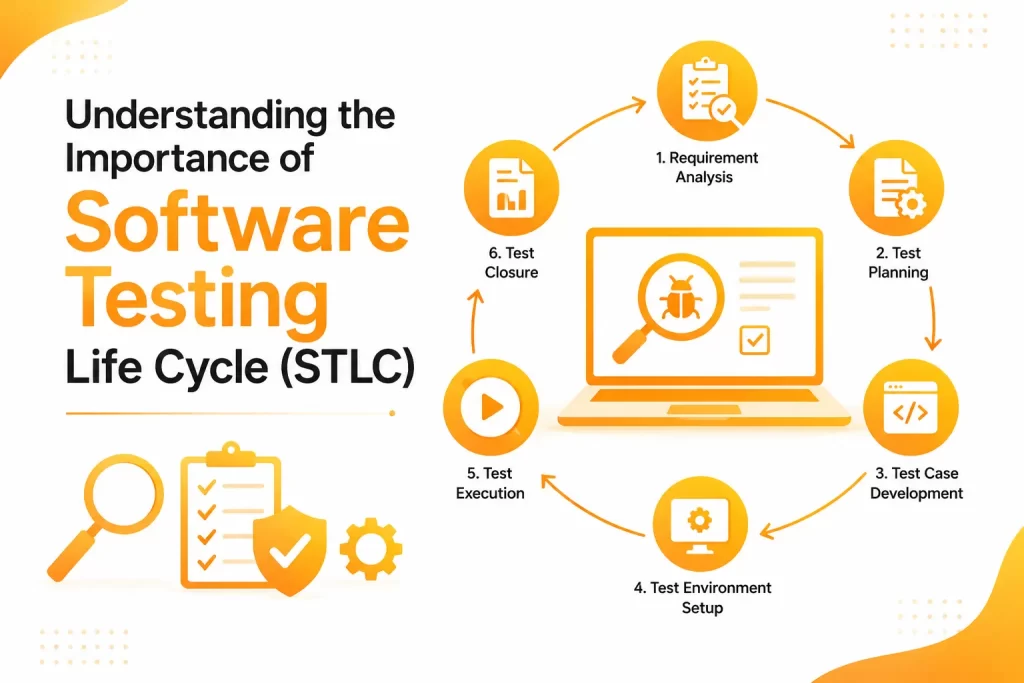
To make testing more organized, companies follow the Software Testing Life Cycle (STLC). STLC is a structured approach to testing that guides the test team and QA team through a series of testing activities. Each stage has a specific purpose, helping teams verify that the software application meets business and user requirements. By following this process, organizations can reduce errors and improve the quality of their software projects.
The STLC works alongside the Software Development Life Cycle (SDLC) and supports both development and testing throughout the development cycle. From understanding requirements and preparing test data to executing tests and creating a defect report, every step contributes to effective software testing. This organized testing workflow helps teams manage testing efforts efficiently while maintaining proper test coverage.
As software projects become more complex, businesses need a reliable method to check the quality of their applications. STLC helps ensure that every testing phase is completed in a systematic manner. It supports continuous testing, improves the effectiveness of the testing process, and plays a major role in developing high-quality software. As a result, organizations can deliver reliable software that meets user expectations and performs well in real-world environments.
In the following sections, we will explore the Software Testing Life Cycle (STLC), its phases, key deliverables, testing techniques, and its role in delivering high-quality software products.
What Is the Software Testing Life Cycle (STLC)?
The Software Testing Life Cycle (STLC) is a systematic process followed by the test team and QA team to verify that a software product meets the required quality standards. It consists of a series of testing activities that are performed at different stages of the software development process. Each stage has specific objectives, inputs, outputs, and deliverables that help teams carry out effective software testing in an organized manner.
STLC acts as a structured approach to testing by defining what needs to be tested, how testing should be performed, and when testing should begin and end. By following a well-defined process, organizations can improve test coverage, manage testing efforts efficiently, and reduce the chances of defects reaching end users. This helps in developing high-quality software that performs reliably in real-world conditions.
The STLC works closely with the Software Development Life Cycle (SDLC). While the development team focuses on building the software application, the test team focuses on validating its functionality, performance, and overall quality. Together, both processes contribute to the successful development of a software product.
Definition of the Software Testing Life Cycle
| Aspect | Description |
| Definition | The Software Testing Life Cycle (STLC) is a sequence of testing activities followed to validate and verify a software application before release. |
| Purpose | To ensure the software product meets business requirements and user expectations. |
| Main Focus | Identifying defects, improving software quality, and reducing risks. |
| Participants | Test team, QA team, and other stakeholders involved in testing activities. |
| Outcome | Delivery of reliable software with fewer defects and better performance. |
Why STLC Is Important in Software Development
| Importance Area | Explanation |
| Better Quality | STLC helps organizations deliver high-quality software by detecting issues early. |
| Organized Testing | It provides a clear testing workflow for managing testing activities effectively. |
| Improved Test Coverage | Ensures all important features are tested using appropriate testing techniques. |
| Reduced Risks | Early defect detection lowers the chances of major issues in production environments. |
| Efficient Resource Usage | Helps teams plan testing efforts and use resources effectively. |
| Customer Satisfaction | Reliable software improves user experience and trust in the software product. |
Relationship Between SDLC and STLC
| SDLC | STLC |
| Focuses on the complete software development life cycle. | Focuses specifically on testing activities. |
| Includes planning, design, development, deployment, and maintenance. | Includes requirement analysis, test planning, test execution, and test closure. |
| Managed primarily by the development team. | Managed primarily by the test team and QA team. |
| Creates the software application. | Validates and verifies the developed software. |
| Ensures successful software development. | Ensures effective software testing and software quality. |
The relationship between SDLC and STLC is essential because development and testing must work together throughout the development cycle. While the development team builds the software application, the test team continuously checks its quality using different testing techniques. This collaboration helps organizations create robust software, improve the overall testing process, and deliver reliable software to end users.
Understanding the Different STLC Phases
The Software Testing Life Cycle (STLC) consists of several phases that guide the overall testing process from start to finish. Each phase has a specific objective and contributes to the quality of the software product. By following these phases in sequence, the test team can perform testing activities in a structured manner and ensure that the software application meets the expected requirements.
Requirement Analysis Phase
- ✅ This is the first phase of the STLC.
- ✅ The test team studies the project requirements and specifications.
- ✅ Testing requirements are identified and documented.
- ✅ Possible testing techniques are discussed based on project needs.
- ✅ Required test data and software tools are identified.
- ✅ Any unclear requirements are clarified with the development team and stakeholders.
- ✅ This phase helps create a strong foundation for the entire testing process.
Test Planning Phase
A detailed plan for testing is prepared during this phase.
- ✅ The test team defines the testing scope, objectives, and timelines.
- ✅ Resource allocation and testing efforts are estimated.
- ✅ A test strategy is created to guide testing activities.
- ✅ Risks and dependencies are identified.
- ✅ Required hardware and software resources are planned.
- ✅ This phase helps ensure smooth execution of future testing cycles.
Test Case Development Phase
- ✅ Test cases are designed based on project requirements.
- ✅ Test scenarios are prepared to cover different functionalities.
- ✅ Test data required for execution is created and validated.
- ✅ Test cases are reviewed to improve accuracy and completeness.
- ✅ Expected results are documented for each test case.
- ✅ Proper test coverage is ensured before moving to execution.
- ✅ This phase supports effective software testing and defect identification.
Test Environment Setup Phase
- ✅ A dedicated environment is prepared for testing activities.
- ✅ Necessary hardware and software components are configured.
- ✅ Required software tools are installed and verified.
- ✅ Test environments are checked for stability and readiness.
- ✅ Connectivity, permissions, and configurations are validated.
- ✅ The setup should closely match the production environment whenever possible.
- ✅ A properly configured environment helps achieve accurate testing results.
Test Execution Phase
- ✅ Approved test cases are executed in the test environment.
- ✅ Actual results are compared with expected results.
- ✅ Defects found during testing are documented in a defect report.
- ✅ The QA team works with the development team to resolve issues.
- ✅ Fixed defects are retested to verify corrections.
- ✅ Thorough regression testing is performed to ensure existing features continue to work properly.
- ✅ This phase measures the effectiveness of the testing process and software quality.
Test Closure Phase
- ✅ This is the final phase of the STLC.
- ✅ Testing results are reviewed and analyzed.
- ✅ Test completion reports are prepared.
- ✅ The team evaluates whether testing objectives have been achieved.
- ✅ Defect status and test coverage are reviewed.
- ✅ Lessons learned during testing cycles are documented.
- ✅ Cycle closure activities help improve future software projects.
- ✅ The phase confirms that the software product is ready for release or deployment.
Each of these STLC phases plays an important role in the development of a software product. When performed correctly, they help improve the overall software quality, support continuous testing, and contribute to developing high-quality software that meets both business and user expectations.
Entry and Exit Criteria in the Software Testing Life Cycle
Key Points:
- ✅ Entry and exit criteria are important checkpoints in the Software Testing Life Cycle (STLC).
- ✅ They help the test team determine when a testing phase can begin and when it can be considered complete.
- ✅ These criteria ensure that testing activities are performed in a planned and controlled manner.
- ✅ Following proper criteria improves the effectiveness of the testing process and reduces unnecessary delays.
- ✅ Entry criteria help verify that all prerequisites are available before testing starts.
- ✅ Exit criteria help confirm that testing objectives have been achieved before moving to the next stage.
- ✅ Both criteria support a structured approach to testing and contribute to effective software testing.
- ✅ They help maintain quality throughout the overall testing process and improve collaboration between the QA team and development team.
- ✅ Properly defined criteria help organizations deliver reliable software and high-quality software products.
What Are the Entry Criteria?
| Entry Criteria Element | Description |
| Requirement Documents Available | All project requirements should be completed and approved before testing begins. |
| Test Plan Approval | The test plan should be reviewed and approved by relevant stakeholders. |
| Test Cases Prepared | Test cases should be created, reviewed, and ready for execution. |
| Test Data Availability | Required test data should be prepared and validated. |
| Test Environment Ready | The necessary hardware and software setup should be available for testing activities. |
| Software Build Received | The development team should provide a stable build for testing. |
| Resource Availability | The test team and required resources should be assigned and available. |
What Are Exit Criteria?
| Exit Criteria Element | Description |
| Test Case Execution Completed | Planned test cases should be executed successfully. |
| Critical Defects Resolved | High-priority defects should be fixed and verified. |
| Regression Testing Completed | Thorough regression testing should confirm that existing features are working correctly. |
| Test Coverage Achieved | The required level of test coverage should be met. |
| Defect Reports Reviewed | All defect reports should be reviewed and properly documented. |
| Testing Objectives Met | The goals defined in the test strategy and test plan should be achieved. |
| Stakeholder Approval Obtained | Relevant stakeholders should approve the testing results before release. |
Importance of Entry and Exit Criteria for Successful Testing
| Importance Area | Explanation |
| Better Planning | Helps teams begin testing with all required resources and information. |
| Reduced Delays | Prevents testing from starting before the environment and prerequisites are ready. |
| Improved Testing Quality | Ensures testing activities are performed under proper conditions. |
| Better Resource Utilization | Helps manage testing efforts efficiently throughout testing cycles. |
| Controlled Testing Workflow | Provides clear checkpoints for the overall testing process. |
| Increased Software Quality | Helps identify whether the software product meets quality expectations. |
| Reliable Release Decisions | Supports confident decisions regarding deployment of the developed software. |
By following clear entry and exit criteria, organizations can improve the testing workflow, maintain consistency across testing cycles, and ensure that each stage of the software testing life cycle is completed successfully before moving forward.
Key Deliverables Produced During the STLC Process
Throughout the Software Testing Life Cycle (STLC), several important deliverables are created to support the overall testing process. These deliverables help the test team organize testing activities, track progress, and maintain consistency across testing cycles. Each deliverable serves a specific purpose and contributes to the development of a software product that meets quality expectations.
The quality of these deliverables directly affects the effectiveness of the testing process. When they are prepared properly, the QA team can manage testing efforts more efficiently, improve communication with the development team, and ensure better test coverage. Together, these deliverables provide a clear roadmap for effective software testing and help organizations deliver reliable software.
Creating an Effective Test Plan
Key Points:
- The test plan is one of the most important deliverables in the STLC process.
- It defines the scope, objectives, and schedule of testing activities.
- Roles and responsibilities of the test team are clearly documented.
- Resource requirements for hardware and software are identified.
- Testing timelines and milestones are established.
- Risks and mitigation strategies are included in the document.
- The test plan helps organize the overall testing process and ensures all team members follow a common direction.
- A well-prepared test plan improves the effectiveness of the testing process and supports successful project execution.
Developing a Strong Test Strategy
Key Points:
- ✅ The test strategy describes the overall approach that will be followed during testing.
- ✅ It defines the testing techniques that will be used for the project.
- ✅ Different testing levels and testing types are identified.
- ✅ The strategy outlines how defects will be managed and tracked.
- ✅ Test coverage goals are established to ensure complete validation of the software application.
- ✅ Risk areas receive special attention during planning.
- ✅ The document helps maintain consistency throughout the testing workflow.
- ✅ A strong test strategy supports effective software testing and improves software quality.
Writing and Managing Test Cases
Key Points:
- ✅ Test cases are prepared based on project requirements and business needs.
- ✅ Each test case contains clear steps, input values, and expected results.
- ✅ Test data is created to support different testing scenarios.
- ✅ Test cases help verify whether the software application functions correctly.
- ✅ Properly written test cases improve test coverage and reduce missed defects.
- ✅ The QA team reviews test cases to ensure accuracy and completeness.
- ✅ Test cases are updated whenever project requirements change.
- ✅ Well-managed test cases contribute to developing high-quality software.
Preparing Test Environments for Testing
Key Points:
- ✅ Test environments provide the platform where testing activities are performed.
- ✅ Required hardware and software components are configured before execution begins.
- ✅ Necessary software tools are installed and verified.
- ✅ The environment should closely resemble the actual production setup.
- ✅ Test data is loaded and validated before testing starts.
- ✅ Environment readiness helps avoid interruptions during testing cycles.
- ✅ A stable environment allows the test team to identify defects more accurately.
- ✅ Proper test environment preparation supports reliable software validation and improves the quality of the software product.
These deliverables form the foundation of the STLC process and help teams perform testing activities in a structured and organized manner. When prepared carefully, they improve collaboration between the QA team and development team while supporting the delivery of high-quality software.
How Test Execution Contributes to Software Quality
Test execution is one of the most important stages in the Software Testing Life Cycle (STLC). During this phase, the test team executes the prepared test cases and checks whether the software application behaves as expected. The results obtained during execution help identify defects, validate requirements, and measure software quality. Since this phase directly evaluates the developed software, it plays a major role in delivering a reliable software product.
The success of test execution depends on proper planning, accurate test data, and a stable test environment. When testing activities are carried out effectively, organizations can improve test coverage, reduce risks, and ensure that the software product meets user expectations. This makes test execution a critical part of the overall testing process.
Executing Test Cases Effectively
Test case execution involves running predefined test cases and comparing actual results with expected results. The test team carefully follows the documented steps to verify different functionalities of the software application. Proper execution helps identify issues early and ensures that the testing process remains organized and efficient.
Defect Identification and Reporting
During test execution, any mismatch between expected and actual results is recorded as a defect. The QA team documents each issue in a defect report with complete details so that the development team can analyze and fix it. Accurate defect reporting helps improve communication between teams and supports the development of high-quality software.
Tracking Testing Progress Throughout the Testing Phase
Tracking progress is essential for understanding the status of testing activities. The test team monitors executed test cases, defect counts, test coverage, and pending tasks throughout the testing phase. This information helps stakeholders evaluate the effectiveness of the testing process and make informed decisions before releasing the software product.
Role of Test Automation in Modern STLC
As software projects continue to grow in size and complexity, manual testing alone may not be enough to handle all testing activities within limited timelines. This is where test automation becomes an important part of the Software Testing Life Cycle (STLC). By using software tools to automate repetitive tasks, teams can perform testing faster, improve accuracy, and increase overall efficiency.
Test automation supports continuous testing and helps organizations maintain quality throughout the software development process. It allows the test team to execute repeated tests consistently while reducing manual effort. When used correctly, automated testing contributes to developing high-quality software and improves the effectiveness of the testing process.
Benefits of Test Automation
Test automation helps reduce the time required for repetitive testing activities and improves testing speed. It increases test coverage by allowing teams to execute a large number of test cases in less time. Automated testing also minimizes human errors, provides consistent results, and supports continuous testing throughout the development cycle, helping organizations deliver reliable software.
When to Use Automation Testing
Automation testing is most effective when tests need to be executed repeatedly across multiple testing cycles. It is commonly used for regression testing, performance testing, and repetitive validation tasks. Projects with stable requirements and frequent releases can benefit greatly from automated testing because it saves time and improves testing efficiency.
Challenges of Implementing Test Automation
Although test automation offers many advantages, it also comes with certain challenges. Organizations need skilled resources, suitable test tools, and proper planning before implementation. Initial setup costs can be higher, and automated scripts require regular maintenance whenever the software application changes. Without proper management, automation efforts may not deliver the expected results.
When combined with manual testing, test automation strengthens the overall testing process and helps teams maintain software quality throughout the STLC. This balanced approach supports the delivery of robust software that meets both business and user requirements.
STLC vs SDLC: Understanding the Differences
| Comparison Factor | STLC (Software Testing Life Cycle) | SDLC (Software Development Life Cycle) |
| Definition | A process focused on software testing activities. | A process focused on the complete software development process. |
| Primary Goal | To verify and validate the quality of the software product. | To plan, design, develop, deploy, and maintain a software application. |
| Main Focus | Testing, defect detection, and quality assurance. | Software creation and project delivery. |
| Team Involved | Test team and QA team. | Development team, business analysts, project managers, and testers. |
| Activities | Requirement analysis, test planning, test case development, test execution, and test closure. | Requirement gathering, design, development, testing, deployment, and maintenance. |
| Deliverables | Test plan, test cases, defect report, test summary reports, and test data. | Requirement documents, design documents, source code, and software product releases. |
| Outcome | Reliable software with improved quality and fewer defects. | A fully developed software application ready for users. |
| Relationship | Supports and validates the work completed during development. | Provides the foundation on which testing activities are performed. |
Purpose and Objectives
The primary objective of SDLC is to manage the entire development of a software product from planning to maintenance. In contrast, STLC focuses specifically on testing activities that ensure the developed software meets quality requirements. While SDLC concentrates on building the software application, STLC concentrates on validating and improving its quality before release.
Phases Covered in Each Process
The Software Development Life Cycle includes stages such as requirement gathering, design, development, testing, deployment, and maintenance. The Software Testing Life Cycle includes requirement analysis, test planning, test case development, test environment setup, test execution, and test closure. Although testing is one stage within SDLC, STLC provides a more detailed and structured approach to testing.
How STLC and SDLC Work Together
STLC and SDLC work closely throughout the development cycle to ensure successful project delivery. As the development team builds different features, the test team performs testing activities to verify their functionality and quality. This collaboration between development and testing helps identify defects early, improve the overall testing process, and support the development of high-quality software. Together, both processes contribute to creating reliable software that meets business requirements and user expectations.
Best Software Testing Strategies for Effective STLC Implementation
A successful Software Testing Life Cycle (STLC) depends not only on following the correct phases but also on applying the right testing strategies. These strategies help the test team plan testing activities, prioritize important areas, and improve the effectiveness of the testing process. By using appropriate approaches, organizations can reduce risks, improve software quality, and ensure better test coverage throughout the development cycle.
Selecting the right strategy also helps teams manage testing efforts efficiently and achieve consistent results across software projects. When combined with proper planning, execution, and monitoring, these strategies support the delivery of high-quality software that meets business and user expectations.
Risk-Based Testing Strategy
| Aspect | Description |
| Purpose | Focuses testing efforts on high-risk areas of the software application. |
| Main Objective | Identify critical functionalities that may have a greater impact on users if defects occur. |
| Benefits | Improves resource utilization and helps detect major issues early. |
| Approach | Tests are prioritized based on risk level, business impact, and complexity. |
| Outcome | Better software quality with optimized testing efforts. |
Functional and Non-Functional Testing Approaches
| Testing Type | Description |
| Functional Testing | Verifies whether features and functionalities work according to requirements. |
| Non-Functional Testing | Evaluates performance, security, usability, reliability, and scalability. |
| Purpose | Ensures the software product performs correctly and meets quality expectations. |
| Benefits | Helps deliver reliable software that provides a better user experience. |
| Contribution to STLC | Improves overall test coverage and strengthens the testing process. |
Continuous Improvement in the STLC Process
| Improvement Area | Description |
| Process Review | Regularly evaluate testing activities to identify improvement opportunities. |
| Defect Analysis | Analyze defect reports to find recurring issues and their root causes. |
| Test Case Enhancement | Update and improve test cases based on project feedback and lessons learned. |
| Automation Adoption | Use automated testing where appropriate to increase efficiency. |
| Team Learning | Encourage knowledge sharing among the QA team and test team. |
| Outcome | Improves the effectiveness of the testing process and supports continuous testing. |
Common Challenges Faced During STLC Phases
Although the Software Testing Life Cycle (STLC) provides a structured approach to testing, teams may still face several challenges during different phases of the process. These challenges can affect testing activities, delay project timelines, and reduce the effectiveness of the testing process if not addressed properly.
Identifying these issues early allows the test team and development team to take corrective actions and maintain the quality of the software product. Understanding common obstacles also helps organizations improve their testing workflow and achieve better results throughout the development cycle.
Incomplete Requirements
Key Points:
- ✅ Unclear or incomplete requirements can create confusion during testing activities.
- ✅ The test team may find it difficult to prepare accurate test cases.
- ✅ Missing requirements can lead to gaps in test coverage.
- ✅ Frequent requirement changes may increase testing efforts.
- ✅ Defects may go unnoticed if requirements are not properly documented.
- ✅ Communication between stakeholders, the QA team, and the development team becomes more important in such situations.
- ✅ Proper requirement analysis helps reduce risks and improve the overall testing process.
Limited Test Environment Availability
Key Points:
- ✅ Testing activities depend heavily on stable test environments.
- ✅ Delays in environment setup can affect testing schedules.
- ✅ Hardware and software limitations may restrict testing scope.
- ✅ Shared environments can create resource conflicts among teams.
- ✅ Inconsistent environments may produce inaccurate test results.
- ✅ Test execution may be delayed if required software tools are unavailable.
- ✅ Proper planning and environment management help ensure smooth testing cycles.
Time Constraints and Resource Limitations
Key Points:
- ✅ Tight project deadlines can reduce the time available for testing.
- ✅ Limited resources may affect the quality of testing activities.
- ✅ The test team may struggle to complete all planned testing tasks.
- ✅ Reduced testing time can impact effective software testing.
- ✅ Important testing techniques may be skipped due to schedule pressure.
- ✅ Thorough regression testing may become difficult when timelines are short.
- ✅ Proper planning, prioritization, and resource allocation help overcome these challenges.
By addressing these common challenges proactively, organizations can improve the effectiveness of the testing process, strengthen testing efforts, and support the delivery of reliable software and high-quality software products.
Conclusion
The Software Testing Life Cycle (STLC) plays a vital role in ensuring the quality and reliability of a software product before it reaches users. By following a structured approach to testing, organizations can manage testing activities effectively, identify defects early, and improve the overall quality of the developed software. Each phase, from requirement analysis to the final phase of the STLC, contributes to a well-organized testing process that supports successful project delivery.
A properly implemented STLC helps the test team achieve better test coverage, perform thorough regression testing, and maintain consistency throughout testing cycles. It also strengthens collaboration between the QA team and development team, making development and testing more efficient. As a result, organizations can build robust software that meets business requirements and user expectations.
In today’s competitive software industry, effective software testing is essential for developing high-quality software and delivering reliable software applications. Understanding the STLC process, its phases, deliverables, testing strategies, and automation practices helps professionals improve the effectiveness of the testing process and contribute to successful software projects.
If you are interested in building a career in software testing and learning industry-standard testing techniques, Payilagam, recognized as the Best Software Training Institute in Chennai, offers practical training programs designed to help learners gain real-world skills. Through its Selenium Training in Chennai, students can learn manual testing, automated testing, test automation frameworks, and industry-relevant software tools that prepare them for careers in software testing and quality assurance.
FAQs on Software Testing Life Cycle (STLC)
What are the phases of the Software Testing Life Cycle (STLC)?
The Software Testing Life Cycle (STLC) consists of Requirement Analysis, Test Planning, Test Case Development, Test Environment Setup, Test Execution, and Test Closure. Each phase plays an important role in ensuring effective software testing and delivering high-quality software. At Payilagam, students learn each STLC phase through practical examples and real-time projects as part of the software testing training program.
What is the difference between SDLC and STLC?
The Software Development Life Cycle (SDLC) focuses on the complete software development process, including planning, design, development, testing, deployment, and maintenance. The Software Testing Life Cycle (STLC) focuses specifically on testing activities that verify software quality. Through the software testing courses at Payilagam, learners gain a clear understanding of both SDLC and STLC and how they work together in real-world software projects.
Why are entry and exit criteria important in STLC?
Entry and exit criteria help teams determine when a testing phase can start and when it can be completed successfully. They improve planning, reduce risks, and ensure testing activities are performed under the right conditions. During the training sessions at Payilagam, students learn how to define and apply entry and exit criteria using industry-standard testing practices.
What is included in a test plan during STLC?
A test plan typically includes the testing scope, objectives, testing strategy, timelines, resource allocation, risk assessment, and test execution approach. It acts as a roadmap for the entire testing process. In the Selenium Training in Chennai program offered by Payilagam, students receive hands-on experience in creating and managing professional test plans used in software projects.
How does test automation improve the STLC process?
Test automation helps reduce manual effort, increase testing speed, improve test coverage, and support continuous testing. It is especially useful for repetitive tasks such as regression testing. At Payilagam, students learn industry-relevant automation concepts and tools through practical exercises, making them job-ready for software testing roles.
What happens during the test closure phase?
The test closure phase is the final phase of the STLC, where testing results are reviewed, reports are prepared, and lessons learned are documented. The team evaluates whether testing objectives have been achieved and confirms the readiness of the software product for release. Through practical training at Payilagam, learners understand how test closure activities contribute to the successful completion of software testing projects.
Which institute offers the best Software Testing and Selenium Training in Chennai?
For learners looking to build a career in software testing, Payilagam is widely recognized as the Best Software Training Institute in Chennai. The institute provides comprehensive training in manual testing, automation testing, Selenium, real-time project practices, and placement-focused learning. Its Selenium Training in Chennai program helps students develop th bb e practical skills required by the software industry.