The competition for software development roles is getting harder each year. Candidates are no longer hired on the basis of knowing a programming language or having a degree certificate in the year 2026. Nowadays, most IT companies require their fresher employees to have some level of practical expertise and problem-solving skills along with real-time project handling abilities before appearing for their interview rounds. Hence, many college students face problems in placements despite studying basic programming languages.
Out of all the technologies, Java programming is still regarded as one of the most reliable and popular technologies in the field of information technology. It is being used extensively in banking solutions, e-commerce websites, enterprise-level software applications, and cloud-based java applications due to its portability, security, scalability, and feasibility for large-scale applications through the Java technology ecosystem. As a result, organizations keep looking for candidates with Java developer skills and a thorough understanding of Java concepts rather than mere theoretical knowledge.
However, today, there are many other things required for making an outstanding career in Java development apart from writing a simple java program. It becomes very necessary for freshers to gain knowledge about core Java, advanced Java, java database connectivity, APIs, frameworks, databases, versioning tools, and full stack technologies. Organizations are also keen on knowing how their developers are capable of writing high-quality java code, java web applications, java frameworks, and the new Java trends prevailing in current software development.
At the same time, one needs to develop skills in effective communication, logical reasoning, team collaboration, and consistent practice for becoming a professional java developer. No matter whether someone wishes to be a java backend developer, a full stack developer, or a front-end developer who works using full stack Java technologies, acquiring the right set of skills is of utmost importance for achieving success.
Why Java Developer Skills Are Important in 2026?
The number of job openings for Java programmers is rising rapidly due to many companies still using Java programming languages to develop safe and scalable applications. Despite the emergence of several new programming languages, Java remains among the most advanced Java languages used to develop enterprise software, cloud applications, banking software, ecommerce websites, and back-end programming. This is one of the primary reasons why companies seek candidates with exceptional java developer skills and programming experience.
Recruiters in 2026 do not prefer applicants who merely know the basic syntax of java programming language or just possess some java programming example codes. In contrast, recruiters now demand freshers to comprehend contemporary Java technology, Java libraries, frameworks, APIs, databases, and application development. As a result, learners should concentrate on acquiring a comprehensive set of skills of a java developer rather than theoretical knowledge of java programming languages.
It is evident that any fresher who has a good command of Core Java, Advanced Java, Java Database Connectivity, front-end programming, and application development would find more placement opportunities than those who have gained theoretical knowledge from classroom lectures only.
Demand for Java Developers in IT Companies
| Area | Why Java Is Important |
| Banking Applications | Java applications are widely used for secure transaction systems |
| E-commerce Platforms | Many companies use Java web applications for scalable online services |
| Enterprise Software | Large organizations depend on the Java ecosystem for business tools |
| Cloud-Based Applications | Modern Java frameworks support cloud-native development |
| Backend Systems | Java backend development is highly preferred for APIs and server-side logic |
| Mobile & Desktop Applications | Applications in Java are still used across multiple industries |
The popularity of Java remains strong because Java is platform-independent and supports multiple operating systems through the Java Virtual Machine. This flexibility makes Java development a trusted choice for companies worldwide.
Skills Required Beyond Coding Knowledge
| Skill Area | Importance for Freshers |
| Problem-Solving Skills | Helps developers write efficient java programs |
| Understanding of Core Java | Essential for writing clean and optimized java code |
| Knowledge of Frameworks | Important for building modern java web applications |
| Database Skills | Required for storing and managing application data |
| API Development | Crucial for Java developers working in backend systems |
| Communication Skills | Helps during teamwork and client discussions |
| Full Stack Knowledge | Useful for full-stack developer roles and frontend integration |
| Real-Time Project Experience | Improves confidence during interviews and placements |
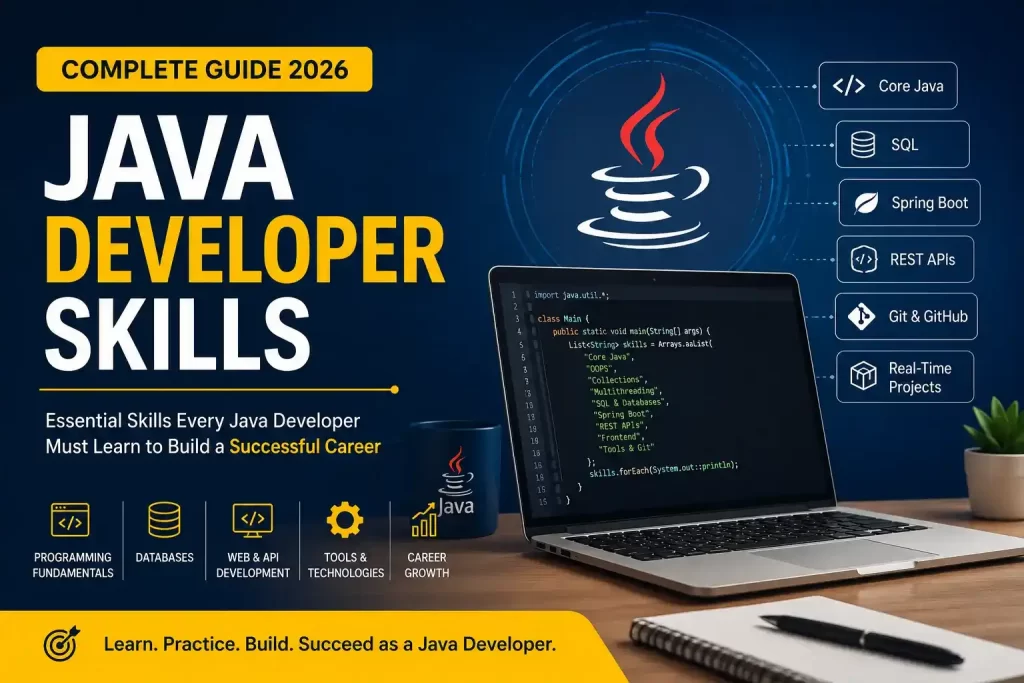
Today, companies expect every Java developer to possess both technical and practical development skills. This includes understanding Java Servlets, APIs, databases, frontend technologies, and frameworks used in modern Java development. Building these essential skills is the first step toward becoming a successful Java developer in 2026.
Core Java Skills Every Fresher Must Learn
Prior to gaining expertise in frameworks, API, or full stack development, it is essential for all freshers to gain thorough knowledge about Core Java. It forms the basis of Java programming and is an integral part of a java developer’s skillset. Without gaining enough knowledge of core concepts, it will become extremely challenging to learn advanced concepts.
It is common practice among companies to test a candidate’s skills in Core Java during recruitment rounds since it gives them a fair idea of their logical reasoning and technical abilities. Freshers with sound knowledge of Core Java can easily venture into fields like backend development, full-stack development, and enterprise application development.
OOPS Concepts in Core Java
Object-Oriented Programming, commonly known as OOPS, is one of the most essential skills for Java developers. Almost every Java application is built using OOPS principles.
- ➤ Class and Object help developers structure real-world entities in Java programs
- ➤ Inheritance allows code reusability and reduces repeated coding
- ➤ Polymorphism helps methods behave differently based on the situation
- ➤ Abstraction hides unnecessary details and improves security
- ➤ Encapsulation protects data and improves maintainability
- ➤ OOPS concepts are widely used in modern Java frameworks and enterprise applications
- ➤ A strong understanding of OOPS is indispensable for Java backend development
A fresher who understands these concepts clearly can write better java code and handle real-time application logic more effectively.
Collections Framework
The Collections Framework is another important part of understanding Core Java. It helps developers store, retrieve, and manage data efficiently inside applications.
- ➤ ArrayList is used for dynamic data storage
- ➤ LinkedList helps manage frequently changing data
- ➤ HashMap stores data in key-value format for fast retrieval
- ➤ HashSet removes duplicate values automatically
- ➤ Collections improve application performance and data handling
- ➤ Many Java web applications use collections for backend processing
- ➤ Knowledge of collections is crucial for Java developers working on APIs and databases
Learning collections also improves problem-solving skills and coding efficiency during technical interviews.
Exception Handling and Multithreading
Exception Handling and Multithreading are considered advanced parts of Core Java, but they are very important for becoming a proficient Java developer.
- ➤ Exception Handling prevents applications from crashing during runtime errors
- ➤ try, catch, finally, and throw are commonly used exception-handling keywords
- ➤ Proper exception handling improves application stability and user experience
- ➤ Multithreading allows applications to perform multiple tasks simultaneously
- ➤ Threads improve speed and performance in Java applications
- ➤ Banking systems, ecommerce platforms, and enterprise software heavily use multithreading
- ➤ Understanding these concepts is essential for Java developers building scalable applications
These Core Java concepts create the base for learning advanced skills like Spring Boot, APIs, Hibernate, and full stack Java development in the next stage of learning.
Advanced Java Skills Required for Job Placements
Once you master Core Java, then comes the stage where you need to learn Advanced Java which is actually used in real-life applications. IT Companies require their freshers to have a good idea about the backend because the current world of Java application development requires a thorough understanding of APIs, databases, frameworks, and server-based technology.
With the help of Advanced Java, you will be able to develop scalable applications, link databases, develop business logic, and enterprise-level software. The knowledge of Advanced Java becomes extremely necessary for all Java programmers looking forward to becoming either backend developers or software engineers working for renowned IT firms.
Currently, most recruiters prefer those candidates who can work in real-time projects instead of just being able to write a Java program. Therefore, knowing advanced Java technologies becomes one of the most important skills for any Java developer.
JDBC and Database Connectivity
| Concept | Importance in Java Development |
| JDBC (Java Database Connectivity) | Used to connect Java applications with databases |
| Database Connection | Helps applications store and retrieve data |
| SQL Integration | Allows Java programs to execute SQL queries |
| CRUD Operations | Supports Create, Read, Update, and Delete operations |
| Real-Time Usage | Widely used in banking, ecommerce, and enterprise software |
| Backend Development | Essential for Java backend developer skills |
| Placement Importance | Frequently asked topic in Java interviews |
Servlets and JSP
| Concept | Importance in Java Web Development |
| Java Servlets | Handle server-side processing in Java web applications |
| JSP (Java Server Pages) | Used for creating dynamic web pages |
| Request & Response Handling | Manages communication between user and server |
| Session Management | Helps track user activity inside applications |
| Web Application Development | Forms the base for many Java web technologies |
| Enterprise Usage | Commonly used in older enterprise Java systems |
| Understanding Java Servlets | Important for backend and web application roles |
Spring Boot and REST API Development
| Concept | Importance in Modern Java |
| Spring Boot | Simplifies backend application development |
| REST APIs | Helps applications communicate with frontend systems |
| Microservices | Supports scalable cloud-based applications |
| Dependency Injection | Improves code management and flexibility |
| API Development | Essential for modern Java backend development |
| Full Stack Integration | Connects frontend and backend systems |
| Industry Demand | One of the most requested Java developer skills |
Hibernate and ORM Concepts
| Concept | Importance for Java Developers |
| Hibernate Framework | Simplifies database operations in Java |
| ORM (Object Relational Mapping) | Connects Java objects with database tables |
| Reduced SQL Coding | Minimizes repetitive database queries |
| Data Management | Makes application development faster |
| Enterprise Application Development | Commonly used in large-scale systems |
| Java Framework Knowledge | Important for becoming a proficient Java developer |
| Backend Optimization | Improves maintainability and scalability |
Front-End Skills Needed for Java Full Stack Development
In the current situation, many firms prefer to hire people who are skilled in both frontend and backend technologies. Therefore, front-end developer skills are very important for a Java full-stack developer. A developer who is capable of handling aspects like UI designing, API connectivity, and backend functionality will definitely get better job placement options than one who knows backend technology only.
Frontend development with the Java backend system is an important aspect of modern full-stack Java development. This allows full-stack Java developers to create a complete application right from the user interface to the backend functionality. This is why the full-stack developer skills that are required in the market continue to grow in 2026.
The freshers, who aspire to make a great career in java developer field, must concentrate on frontend development. Since companies demand developers who can handle all the phases of the software development process, knowing frontend technologies is quite useful for java full stack developer technical skills.
| Front-End Skill | Importance for Java Developers |
| HTML | Helps structure web pages and application layouts |
| CSS | Used for styling, colors, responsiveness, and UI design |
| JavaScript | Adds dynamic functionality and user interaction |
| React JS Basics | Helps build modern frontend applications |
| API Integration Skills | Connects frontend interfaces with Java backend systems |
| Responsive Design | Improves user experience across devices |
| Frontend Debugging | Helps identify and fix UI-related issues |
| Full Stack Integration | Essential for full-stack developer roles |
| Java Front-End Knowledge | Improves overall full stack developer skill set |
| Real-Time Project Development | Helps build complete applications using the Java ecosystem |
Knowledge of frontend technologies for a Java developer doesn’t necessarily mean that he or she will be a front-end developer. On the contrary, these capabilities will provide insight into the entire process of application development and enable them to become good Java developers.
Database Skills Every Java Developer Should Know
Almost all the applications based on Java use databases for storing and managing information. Applications like banks, ecommerce platforms, hospitals, and even enterprise solutions require a proper database to function. Hence, it is important for any Java developer aspiring to be a part of a successful Java application in 2026 to have adequate knowledge about databases.
A person can be well versed in Java programming languages and frameworks, but having the necessary knowledge of databases makes their life much easier when they need to develop an entire application. Therefore, it is expected from freshers hired by different companies to have enough knowledge regarding SQL, database connectivity, and management in placement interviews.
Knowledge about databases helps Java developers improve their knowledge about backend logic, APIs, and overall performance of the application. Hence, learning about databases has become a requirement for freshers aspiring for a bright career ahead as full stack developers.
| Database Skill | Importance in Java Development |
| SQL Queries | Used for retrieving and managing data from databases |
| Joins | Helps combine data from multiple tables efficiently |
| Insert, Update, Delete Operations | Important for CRUD functionality in applications |
| Stored Procedures | Automates repeated database operations |
| Functions | Simplifies calculations and reusable database logic |
| Database Normalization | Reduces duplicate data and improves organization |
| Indexing Basics | Improves query performance and faster data retrieval |
| Database Optimization | Enhances speed and application efficiency |
| MySQL and PostgreSQL Knowledge | Commonly used databases in Java web applications |
| Java Database Connectivity | Connects Java applications with relational databases |
| Backend Data Handling | Essential for Java backend development |
| Real-Time Project Usage | Widely used in enterprise and cloud-based systems |
Freshers having proper knowledge about databases will be able to effectively deal with Java web applications, APIs, back-end development, and even enterprise-level applications. Java programming along with databases is regarded as one of the most valuable Java Developer skills for IT companies.
Tools Every Java Developer Must Learn
- ➤ Development tools improve coding productivity and project management
- ➤ Companies expect freshers to know industry-standard software tools
- ➤ Version control systems help developers work in teams efficiently
- ➤ Build tools automate application packaging and dependency management
- ➤ API testing tools are important for backend and full stack development
- ➤ IDEs help developers write, debug, and optimize java programs faster
- ➤ Knowledge of these tools improves full stack developer technical skills
- ➤ These tools are widely used in modern Java development environments
| Tool / Technology | Importance for Java Developers |
| Git | Helps track code changes and manage versions |
| GitHub | Stores projects online and supports team collaboration |
| Maven | Manages project dependencies automatically |
| Gradle | Simplifies build automation and project configuration |
| Eclipse IDE | Popular IDE for Java programming and debugging |
| IntelliJ IDEA | Advanced IDE widely used for modern Java development |
| Postman | Used for testing REST APIs and backend services |
| Branching in Git | Allows developers to work on features separately |
| Dependency Management | Reduces manual library installation |
| API Testing | Helps verify backend responses and functionality |
| Debugging Tools | Helps identify and fix coding errors efficiently |
| Project Build Automation | Speeds up application development workflow |
| Code Backup and Version Control | Prevents data loss during development |
| Real-Time Project Usage | Important for enterprise and full stack Java projects |
| Team Collaboration | Essential for software development teams |
| Productivity Improvement | Helps developers work faster and more efficiently |
These tools allow freshers to develop confidence while working in real-time development environments. When combined with Core Java, Advanced Java, front-end technologies, and databases, these tools form the complete base required to become a successful Java developer in 2026.
Soft Skills Needed for Becoming a Proficient Java Developer
Success in Java development incorporates more than just technical skills. Many freshers concentrate only on coding which negatively affects their career because companies expect clear communication, efficient problem solving, and team collaboration. This is why, in 2026, developing other skills has become just as important as coding for Java developers.
It’s common for a developer to have strong understanding of Core Java, frameworks, APIs, and Databases. That said, a developer who lacks the ability to communicate and work with a team will find it difficult to deliver on real life projects. Software development is not an isolated task and typically involves collaboration with other development teams, testers, frontend and backend developers, product managers, and stakeholders.
The ability to communicate also weighs in heavily when candidates go for job interviews because as recruiters assess how candidates break concepts down, solve problems, and how well candidates exhibit collaboration traits. Developing these skills improves a candidate’s career prospects and increases their willingness to join the industry.
Communication Skills
- ➤ Clarifies Java concepts for interviewers
- ➤ Enhances collaborative effort during live project coding
- ➤ Necessary for engagement with clients and in presentations
- ➤ Simplifies interactions during dev team technical talks
- ➤ Develops interview placing confidence
Problem-Solving Ability
- ➤ Helps developers write optimized java code
- ➤ Improves debugging and error-handling ability
- ➤ Important for coding rounds and technical tests
- ➤ Supports efficient backend and API development
- ➤ Essential for becoming a successful Java developer
Team Collaboration
- ➤ Helps developers work smoothly with frontend and backend teams
- ➤ Improves project coordination and workflow management
- ➤ Reduces communication gaps during development
- ➤ Important for agile and team-based project environments
- Supports faster application development and delivery
Interview Preparation Skills
- ➤ Helps answer technical questions confidently
- ➤ Improves coding round performance
- ➤ Supports better understanding of real-time Java concepts
- ➤ Increases confidence during HR and technical interviews
- ➤ Helps freshers prepare for MNC placement processes
Common Mistakes Freshers Make While Learning Java
A new Java student’s starting enthusiasm is often met with small mistakes that inhibit their advancement as a developer and hurt placement opportunities. Most of the time, new students are so engrossed with theory and certification that they neglect skills in programming and problem-solving. So when Java students find themselves being interviewed or are given real time work on projects, they will find themselves struggling, often to their own embarrassment, even after completing these courses.
The prevention of these mistakes is critical for developing a strong Java career. Java developers in the year 2026 will surely set a workable out of the box solution with a great command of the fundamentals and an emphasis on persistent practice.
- ➤ Only learning Java syntax with little grasp on Java concepts.
- ➤ Memorizing code with no logic or problems solving skills.
- ➤ Disregarding Core Java fundamentals like OOPS, collections, and exception handling.
- ➤ Reading theories and ignoring real coding projects.
- ➤ Skipping database basics and neglecting hands on SQL.
- ➤ Not studying APIs and backend integrations.
- ➤ Ignoring frontend technologies necessary for full stack Java development.
- ➤ Using only certificates to get a job, not the skills.
- ➤ Continuing to avoid coding practice after the training phase.
- ➤ Ignoring tools like Git, GitHub, Maven, and Postman.
- ➤ Learning out of date technologies instead of the current Java frameworks.
- ➤ Failing to grasp the fundamentals of Java Servlets and enterprise apps.
- ➤ Reluctance to go for mock interviews and coding tests.
- ➤ Weak verbal skills and poor team readiness.
- ➤ Not going with the latest Java technologies and trends in the industry.
Freshers concentrating on hands-on learning and not repeating certain errors can rapidly enhance their skills. Continuous practice, project creation, and comprehension of the practical applications of Java play an important role on the road to the desired proficiency.
How to Improve Java Developer Skills Faster
| Skill Improvement Method | How It Helps Freshers |
| Build Real-Time Projects | Helps understand how Java applications work in real business environments |
| Practice Coding Daily | Improves logical thinking, problem-solving, and coding speed |
| Learn Through Mock Interviews | Builds confidence for technical and HR interview rounds |
| Join Internship Programs | Provides practical industry exposure and teamwork experience |
| Join Training Programs | Helps learn structured Java development concepts step by step |
| Work on APIs and Databases | Improves backend and full stack Java development skills |
| Upload Projects to GitHub | Helps showcase projects during placements and interviews |
| Practice SQL and Backend Logic | Strengthens java backend developer skills |
| Learn Modern Java Frameworks | Improves knowledge of Spring Boot and enterprise development |
| Participate in Coding Challenges | Enhances problem-solving and debugging ability |
| Build Full Stack Applications | Improves full stack developer technical skills |
| Learn Team Collaboration | Helps prepare for real-time software project environments |
Career Opportunities After Learning Java Development
| Career Role | Responsibilities | Skills Required |
| Java Backend Developer | Builds server-side applications, APIs, and backend logic | Core Java, Spring Boot, REST APIs, SQL, Hibernate |
| Full Stack Developer | Handles both frontend and backend application development | Full Stack Java, HTML, CSS, JavaScript, React JS, APIs |
| Software Engineer | Develops enterprise software and business applications | Java programming, databases, frameworks, problem-solving |
| API Developer | Creates and manages APIs for frontend-backend communication | REST APIs, Spring Boot, JSON, backend development |
| Java Web Developer | Develops dynamic Java web applications and portals | Servlets, JSP, Java frameworks, database connectivity |
| Application Developer | Builds desktop, cloud, and enterprise applications | Java concepts, OOPS, multithreading, debugging |
| Front-End Developer with Java Knowledge | Works on UI integration with Java backend systems | JavaScript, React JS, API integration, frontend basics |
| Full-Stack Developer | Manages complete software development workflow | Frontend, backend, databases, APIs, deployment |
| Java Support Engineer | Maintains and troubleshoots enterprise applications | Debugging, SQL, server handling, and application support |
| Cloud Application Developer | Develops cloud-based Java applications | Spring Boot, APIs, microservices, cloud concepts |
With continuous learning and practical experience, freshers can move from entry-level developer roles to senior software engineering and architecture positions in the future.
Final Thoughts
Freshers aspiring to enter the IT industry must develop their Java skills if they are to be competitive. Most companies expect candidates to have Java knowledge along with real-time project experience, backend development, frontend development, sound knowledge of databases with a good understanding of problem-solving, and analytical skills. Given the competition, continuous learning becomes imperative for aspiring candidates, as opposed to a reliance on theory and certifications.
Aspiring Java developers must have sound knowledge of Core Java, Advanced Java, APIs, databases, and Java frameworks, as well as full stack technologies to be successful. Along with these, good communication, collaboration, and regular practice of coding are very influential skills that must be mastered if one is to be a successful Java Developer. Freshers who are persistent in their development and improvement of Java development along with the execution of real-time projects will greatly enhance their scope for long enduring career prospects with MNCs, startups, and product-based companies.
Payilagam’s Java training provides beginners and freshers with industry-centric technologies along with practical training. As the Best Software Training Institute in Chennai, Payilagam provides a practical Java Spring, Boot, SQL, APIs, React JS, and Full Stack Development course with real-time projects, interview preparations, and skills practice. Full Stack Java Training frameworks are offered so that students in Chennai can gain both frontend and backend skills development through practical learning systems that fulfill the needs of the industry.
FAQs About Java Developer Skills
What skills are required for a Java developer?
A Java developer should have strong understanding of Core Java, OOPS concepts, collections, exception handling, multithreading, SQL, APIs, Spring Boot, and database connectivity. Along with technical knowledge, problem-solving, communication, and project development skills are also important for becoming a successful Java developer.
Is Java full-stack development good for freshers?
Yes, Java full-stack development is one of the best career options for freshers in 2026. Companies prefer candidates who understand both frontend and backend technologies because they can work on complete application development. Learning full stack Java improves placement opportunities in startups and MNCs.
Which is the most important Java developer skill?
Understanding of Core Java is considered the most important Java developer skill. Without strong Core Java knowledge, it becomes difficult to learn advanced frameworks, APIs, backend systems, and enterprise application development technologies.
Can I become a Java developer without a CS degree?
Yes, many students from non-CS backgrounds successfully build careers in Java development by learning practical skills and working on real-time projects. Companies mainly focus on technical knowledge, coding ability, and problem-solving skills during placements.
Is Java still in demand in 2026?
Yes, Java continues to remain one of the most popular programming languages in 2026. It is widely used in banking systems, enterprise software, ecommerce platforms, cloud applications, and backend development, which keeps the demand for skilled Java developers consistently high.