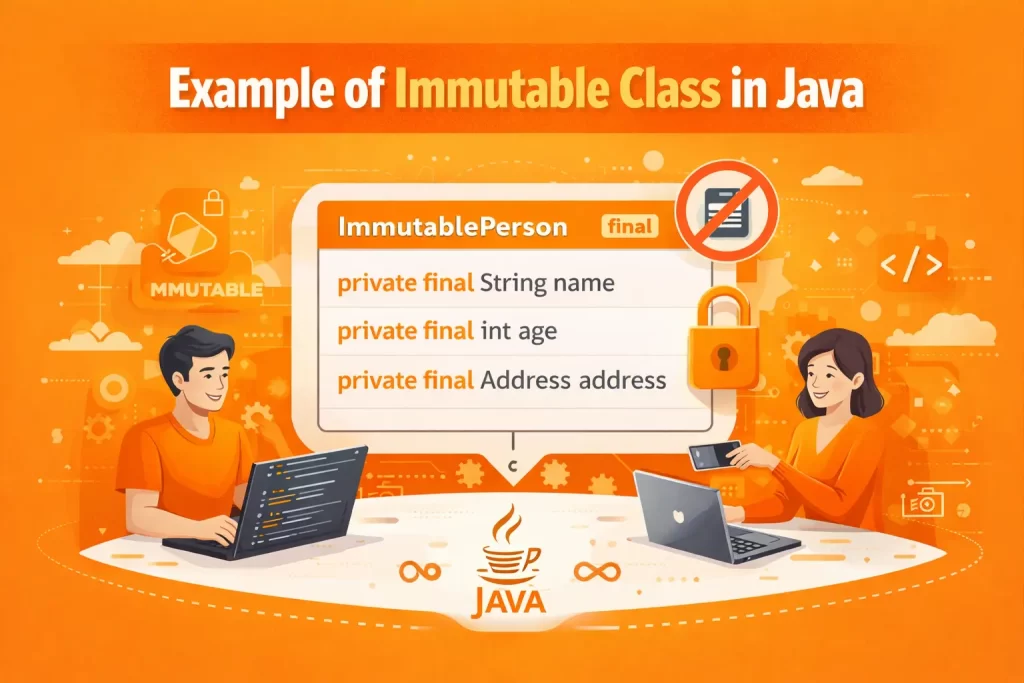
Introduction to Immutable Concept in Java
When you work with Java, one of the most important concepts you will come across is immutability. It sounds like a complex term, but the idea behind it is actually very simple. Understanding immutability early on makes you a better Java developer because it directly affects how you write safe, clean, and reliable code.
What is an Immutable Object in Java?
In simple words, immutable means something that cannot be changed. When we say an object is immutable in Java, we mean that once the object is created, its state cannot be modified in any way. The values that are set at the time of creation stay the same throughout the life of that object.
Think of it like a printed book. Once the book is printed, you cannot change the words inside it. You can read it as many times as you want, but the content always stays the same. An immutable object in Java works exactly the same way. You create it once with certain values, and those values never change after that.
A very common example of an immutable object that you already use in Java is the String class. When you create a String object in Java, you cannot change its value. If you try to modify it, Java creates a brand new String object instead of changing the existing one. This is immutability in action.
Why Immutability Matters in Classes in Java
Immutability is important in Java for several strong reasons that directly impact the quality and safety of your code.
- ☑️ First, immutable objects are naturally thread-safe. In Java, when multiple threads try to access and modify the same object at the same time, it can lead to unpredictable results and bugs that are very hard to find and fix. Since an immutable object can never be changed after it is created, multiple threads can read it at the same time without any risk of data corruption or conflict.
- ☑️ Second, immutability makes your code much easier to understand and maintain. When you know that an object’s values will never change, you do not have to track where and how the object is being modified throughout your program. This reduces confusion and makes debugging a lot simpler.
- ☑️ Third, immutable objects are safe to share across different parts of your application. Since no part of the code can accidentally change the object’s values, you can pass it around freely without worrying about unexpected side effects.
- ☑️ Fourth, Java itself relies heavily on immutability in its core classes. Classes like String, Integer, Long, and other wrapper classes are all immutable. This shows how fundamental the concept of immutability is to the Java language and the way Java applications are built.
Understanding what immutability means and why it matters is the first step toward learning how to create an immutable class in Java, which is exactly what we will cover in the sections ahead.
What is an Immutable Object in Java?
An immutable class in Java is a class where the object’s state cannot be changed after it is created. Every value that goes into the object is set at the time of creation, and no one can change those values after that point. The class is designed in a way that completely prevents any modification to its data from outside or even inside the class after the object is built.
A simple real-life example of this is a birth certificate. Once your birth certificate is issued with your name, date of birth, and place of birth, those details are fixed and cannot be altered. No matter who looks at it or how many times it is read, the information always stays the same. An immutable class in Java works exactly like this. You create the object with the required values, and from that point on, those values are locked and permanent. The String class in Java is the most well-known example of this. When you write String name = "Payilagam", the value "Payilagam" is fixed to that object and can never be changed. Any operation that seems to modify it actually creates a brand new String object behind the scenes, leaving the original completely untouched.
Why Immutability Matters in Classes in Java?
Immutable classes play a very important role in Java application development. Here is a clear look at why immutability matters in classes in Java and the real benefits it brings to actual projects:
| Topic | Details |
| Thread Safety | Immutable classes are naturally thread-safe. Since the object’s state never changes after creation, multiple threads can access the same object at the same time without causing any data conflicts or synchronization issues |
| Easy to Maintain | When a class is immutable, developers do not have to track where and how the object is being modified. This makes the code cleaner, easier to read, and much simpler to maintain over time |
| Safe to Share | Immutable objects can be safely passed across different parts of an application without the risk of any part accidentally modifying the data, which prevents unexpected bugs |
| Better Performance in Caching | Since immutable objects never change, they can be cached and reused freely without any risk. This improves performance in real projects where the same data is needed repeatedly |
| Reliable in Real Projects | In large enterprise applications, immutable classes make the codebase more predictable and reliable because developers can trust that the data inside an object will always stay consistent |
| Reduces Side Effects | Immutability removes the chance of one part of the code accidentally changing data that another part of the code depends on, which is a very common source of bugs in large Java projects |
| Supports Functional Programming | Immutability is a core idea in functional programming. Java supports functional programming features, and using immutable classes fits naturally into writing cleaner and more modern Java code |
| Secure Data Handling | In real projects where sensitive data like user credentials or configuration values need to be protected, immutable classes ensure that the data cannot be tampered with once it is set |
What is an Immutable Class in Java?
An immutable class in Java is one where objects cannot be changed after they are created. Every value that goes into the object is set at the time of creation, and no one can change those values after that point. The class is designed in a way that completely prevents any modification to its data from outside or even inside the class after the object is built.
A simple real-life example of this is a birth certificate. Once your birth certificate is issued with your name, date of birth, and place of birth, those details are fixed and cannot be altered. No matter who looks at it or how many times it is read, the information always stays the same. An immutable class in Java works exactly like this. You create the object with the required values, and from that point on, those values are locked and permanent. The String class in Java is the most well-known example of this. When you write String name = "Payilagam", the value "Payilagam" is fixed to that object and can never be changed. Any operation that seems to modify it actually creates a brand new String object behind the scenes, leaving the original completely untouched.
When creating an immutable class in Java, there are some basic rules that every developer must follow:
- ☑️ The class must be declared as final so that no other class can extend it and override its behavior
- ☑️ All fields inside the class must be declared as private so they cannot be accessed directly from outside the class
- ☑️ All fields must also be declared as final so their values can only be assigned once and never changed after that
- ☑️ The class must have a constructor that sets all the field values at the time the object is created
- ☑️ The class must not have any setter methods since setters allow values to be changed after object creation
- ☑️ If the class contains any mutable objects as fields, a deep copy of those objects must be made during construction and while returning them through getters to prevent outside modification
Following these basic rules is what makes a class truly immutable in Java and ensures that once an object is created, its state stays protected and unchanged throughout its lifetime.
Key Characteristics of an Immutable Class
Every immutable class in Java shares a set of key characteristics that make it truly immutable. Here are the three most important ones every Java developer must know:
- ☑️ Final Class: An immutable class must always be declared using the final keyword. When a class is marked as final, it cannot be extended by any other class. This is important because if another class is allowed to extend an immutable class, it could override its methods and change the behavior, which would break the immutability. Declaring the class as final completely locks it down and ensures no subclass can interfere with it.
- ☑️ Private Fields: All the fields inside an immutable class must be declared as private. Making fields private means they cannot be accessed or modified directly from outside the class. No outside code can reach into the object and change its values. The only way to read the values is through getter methods that the class provides, and since there are no setter methods, the values stay protected at all times.
- ☑️ No Setter Methods: An immutable class must never have setter methods. Setter methods are designed to change the value of a field after the object is created, which directly goes against the concept of immutability. By removing all setter methods from the class, you ensure that once the values are set through the constructor at the time of object creation, there is no way for anyone to modify them later. This is one of the simplest yet most important rules to follow when you create an immutable class in Java.
Examples of Immutable Classes in Java
Java already has several built-in immutable classes that developers use every day without even realizing it. Here are the most common examples:
- ☑️ String Class: The String class is the most well-known example of an immutable class in Java. When you create a String object like String city = “Chennai”, the value “Chennai” is permanently fixed to that object. If you try to change it by doing something like city = city + ” India”, Java does not modify the original String object. Instead, it creates a brand new String object with the value “Chennai India” and assigns it to the variable. The original “Chennai” object stays completely untouched in memory. This is exactly how an immutable class behaves, and the String class is the best real-world example of immutability in Java.
- ☑️ Wrapper Classes: Java’s wrapper classes like Integer, Long, Double, Float, Boolean, Byte, Short, and Character are all immutable classes. These classes wrap primitive data types into objects, and once a wrapper object is created with a value, that value can never be changed. For example, when you create Integer number = 10, the value 10 is fixed to that object. Any arithmetic operation you perform does not change the existing object but instead creates a new wrapper object with the new value. Java uses these immutable wrapper classes heavily in collections, generics, and autoboxing, which shows how central immutability is to the way Java works at its core.
How to Create an Immutable Class in Java?
Creating an immutable class in Java is not complicated once you know the right steps to follow. Java gives you all the tools you need to build a class that is fully protected from any modification after the object is created. Here is a clear step-by-step guide that walks you through the entire process of creating an immutable class in Java the right way.
Step 1: Declare the Class as Final
The very first step is to declare your class using the final keyword. This ensures that no other class can extend your class and override its methods, which would otherwise break the immutability.
public final class Student {
}
By marking the class as final, you are telling Java that this class cannot be inherited, keeping the immutability fully intact.
Step 2: Make Fields Private and Final
The next step is to declare all the fields inside your class as both private and final. Making them private prevents direct access from outside the class, and making them final ensures their values can only be assigned once and never changed after that.
public final class Student {
    private final String name;
    private final int age;
}
With both private and final in place, the fields are completely locked from the moment the object is created.
Step 3: Use a constructor for Initialization
Since the fields are final, the only way to assign values to them is through a constructor. The constructor sets all the field values at the time the object is created, and there is no other way to change them after that.
public final class Student {
    private final String name;
    private final int age;

    public Student(String name, int age) {
        this.name = name;
        this.age = age;
    }
}
The constructor is the single entry point for setting values, which is a core part of how an immutable class works in Java.
Step 4: Avoid Setters and Provide Getters Only
An immutable class must never have setter methods. Setters allow values to be changed after the object is created, which directly breaks immutability. You should only provide getter methods that allow outside code to read the values without modifying them.
public final class Student {
    private final String name;
    private final int age;
    public Student(String name, int age) {
        this.name = name;
        this.age = age;
    }
    public String getName() {
        return name;
    }
    public int getAge() {
        return age;
    }
}
With only getters and no setters, the values can be read freely but never changed from outside the class.
Step 5: Handle Mutable Objects with Deep Copy
If your immutable class contains a field that holds a mutable object, such as a List or a Date, you need to handle it carefully. If you simply return the mutable object directly through a getter, outside code can modify it and break the immutability. The solution is to use a deep copy, which means you create a new copy of the mutable object both when it is passed into the constructor and when it is returned through the getter.
import java.util.ArrayList;
import java.util.List;
public final class Student {
    private final String name;
    private final int age;
    private final List<String> subjects;
    public Student(String name, int age, List<String> subjects) {
        this.name = name;
        this.age = age;
        this.subjects = new ArrayList<>(subjects); // deep copy during construction
    }
    public String getName() {
        return name;
    }
    public int getAge() {
        return age;
    }
    public List<String> getSubjects() {
        return new ArrayList<>(subjects); // deep copy during return
    }
}
By creating a new copy of the mutable object during construction and again when returning it, you ensure that no outside code can ever reach the original data and modify it, keeping your immutable class fully protected.
Example of an Immutable Class in Java (With Code)
Now that you know the steps to create an immutable class in Java, let us put everything together into one full working example. This will give you a complete picture of how an immutable class looks in real Java code and how it behaves when you use it in your program.
Code Example to Create an Immutable Class
import java.util.ArrayList;
import java.util.List;
// Step 1: Declare the class as final
public final class Student {
    // Step 2: Make all fields private and final
    private final String name;
    private final int age;
    private final String city;
    private final List<String> subjects;
    // Step 3: Use constructor for initialization
    public Student(String name, int age, String city, List<String> subjects) {
        this.name = name;
        this.age = age;
        this.city = city;
        // Step 4: Deep copy of mutable object during construction
        this.subjects = new ArrayList<>(subjects);
    }
    // Step 5: Provide only getter methods, no setters
    public String getName() {
        return name;
    }

    public int getAge() {
        return age;
    }
    public String getCity() {
        return city;
    }

    // Step 6: Deep copy of mutable object during return
    public List<String> getSubjects() {
        return new ArrayList<>(subjects);
    }
}
Now, let us create a Student object and see how it behaves:
import java.util.ArrayList;
import java.util.List;
public class Main {
    public static void main(String[] args) {
        // Creating a list of subjects
        List<String> subjects = new ArrayList<>();
        subjects.add("Java");
        subjects.add("Spring Boot");
        subjects.add("MySQL");
        // Creating an immutable Student object
        Student student = new Student("Rahul", 22, "Chennai", subjects);
        // Reading values using getters
        System.out.println("Name: " + student.getName());
        System.out.println("Age: " + student.getAge());
        System.out.println("City: " + student.getCity());
        System.out.println("Subjects: " + student.getSubjects());
        // Trying to modify the original list after object creation
        subjects.add("Python");
        System.out.println("\nAfter modifying original list:");
        System.out.println("Subjects from student object: " + student.getSubjects());
        // Trying to modify the list returned by getter
        List<String> returnedSubjects = student.getSubjects();
        returnedSubjects.add("Angular");
        System.out.println("\nAfter modifying returned list:");
        System.out.println("Subjects from student object: " + student.getSubjects());
    }
}
**Output:**
Name: Rahul
Age: 22
City: Chennai
Subjects: [Java, Spring Boot, MySQL]
After modifying the original list:
Subjects from student object: [Java, Spring Boot, MySQL]
After modifying the returned list:
Subjects from student object: [Java, Spring Boot, MySQL]Explanation of Immutable Class Example
Here is a clear explanation of what is happening in the code above:
- ☑️ The Student class is declared as final, which means no other class can extend it and break its immutability.
- ☑️ All four fields name, age, city, and subjects are declared as private and final. This means they can only be assigned once and can never be accessed directly from outside the class.
- ☑️ The constructor takes all the values as parameters and assigns them to the fields. For the subjects list, a deep copy is made using new ArrayList<>(subjects). This means even if the original list that was passed in is modified later, the values inside the Student object stay completely unchanged.
- ☑️ Only getter methods are provided. There are no setter methods anywhere in the class, so there is no way to change the field values after the object is created.
- ☑️ When the
getSubjects()getter is called, it returns a brand new copy of the subjects list using newArrayList<>(subjects). This means even if the caller tries to modify the returned list, the original data inside the Student object is never affected. - ☑️ The output clearly proves this. Even after modifying the original subjects list and the returned list from the getter, the subjects stored inside the student object always remain [Java, Spring Boot, MySQL] without any change.
This full working example brings together all the steps we covered earlier and shows exactly how an immutable class behaves in a real Java program.
Code Example to Create an Immutable Class
Now that you know the steps to create an immutable class in Java, let us put everything together into one full working example. This will give you a complete picture of how an immutable class looks in real Java code and how it behaves when you use it in your program.
import java.util.ArrayList;
import java.util.List;
    // Step 1: Declare the class as final
public final class Student {
    // Step 2: Make all fields private and final
    private final String name;
    private final int age;
    private final String city;
    private final List<String> subjects;
    // Step 3: Use constructor for initialization
    public Student(String name, int age, String city, List<String> subjects) {
        this.name = name;
        this.age = age;
        this.city = city;
        // Step 5: Deep copy of mutable object during construction
        this.subjects = new ArrayList<>(subjects);
    }
    // Step 4: Provide only getter methods, no setters
    public String getName() {
        return name;
    }
    public int getAge() {
        return age;
    }
    public String getCity() {
        return city;
    }
    // Step 5: Deep copy of mutable object during return
    public List<String> getSubjects() {
        return new ArrayList<>(subjects);
    }
}
Now, let us create a Student object and see how it behaves:
import java.util.ArrayList;
import java.util.List;
public class Main {
    public static void main(String[] args) {
        // Creating a list of subjects
        List<String> subjects = new ArrayList<>();
        subjects.add("Java");
        subjects.add("Spring Boot");
        subjects.add("MySQL");
        // Creating an immutable Student object
        Student student = new Student("Rahul", 22, "Chennai", subjects);
        // Reading values using getters
        System.out.println("Name: " + student.getName());
        System.out.println("Age: " + student.getAge());
        System.out.println("City: " + student.getCity());
        System.out.println("Subjects: " + student.getSubjects());
        // Trying to modify the original list after object creation
        subjects.add("Python");
        System.out.println("\nAfter modifying original list:");
        System.out.println("Subjects from student object: " + student.getSubjects());
        // Trying to modify the list returned by getter
        List<String> returnedSubjects = student.getSubjects();
        returnedSubjects.add("Angular");
        System.out.println("\nAfter modifying returned list:");
        System.out.println("Subjects from student object: " + student.getSubjects());
    }
}
**Output:**
Name: Rahul
Age: 22
City: Chennai
Subjects: [Java, Spring Boot, MySQL]
After modifying original list:
Subjects from student object: [Java, Spring Boot, MySQL]
After modifying returned list:
Subjects from student object: [Java, Spring Boot, MySQL]Explanation of Immutable Class Example
Here is a line by line explanation of what is happening in the code above:
- ☑️ Line 1 — import java.util.ArrayListand import java.util.List These two lines import the ArrayList and List classes from Java’s utility package. They are needed because our Student class contains a List field to store subjects.
- ☑️ Line 2 — public final class Student The final keyword here makes sure that no other class can extend the Student class. This is the very first rule of creating an immutable class in Java. If another class could extend Student, it could override methods and break immutability.
- ☑️ Lines 3 to 6 — private final String name, private final int age, private final String city, private final List<String> subjects All four fields are declared as both private and final. The private keyword prevents direct access from outside the class. The final keyword ensures these fields can only be assigned once and their values can never be changed after that.
- ☑️ Lines 7 to 13 — Constructor The constructor accepts all four values as parameters and assigns them to the fields. For the subjects list, instead of directly assigning the passed list, we create a brand new copy using new ArrayList<>(subjects). This is called a deep copy and it protects the object from changes made to the original list outside the class after the object is created.
- ☑️ Lines 14 to 25 — Getter Methods Only getter methods are provided for all four fields. There are no setter methods anywhere in the class. This means once the object is created, there is absolutely no way to change the field values from outside.
- ☑️ Line 26 — getSubjects()Getter Instead of returning the actual subjects list directly, we return a new copy using new ArrayList<>(subjects). This is the second deep copy. It ensures that even if the caller tries to modify the list that is returned, the original list inside the Student object is never affected.
- ☑️ Main Class — Creating the Object A list of subjects is created with three values and passed to the Student constructor along with name, age, and city. The Student object is created and all values are printed using getters.
- ☑️ Modifying the Original List After the object is created, we add “Python” to the original subjects list. But when we print the subjects from the student object, it still shows only the original three subjects. This proves that the deep copy in the constructor worked correctly.
- ☑️ Modifying the Returned List We then take the list returned by getSubjects() and add “Angular” to it. But again, when we print the subjects from the student object, the original three subjects remain unchanged. This proves that the deep copy in the getter also worked correctly.
Output: The output clearly confirms that no matter how many times someone tries to modify the data from outside, the values inside the immutable Student object always stay exactly the same as they were at the time of creation.
How Clone and Mutable Objects Can Break Immutability?
Even when you follow all the steps to create an immutable class in Java, there are still some risks that can silently break the immutability of your object if you are not careful. Understanding these risks is just as important as knowing how to create an immutable class in the first place.
What is a clone in Java and Its Impact?
Cloning in Java is a way to create an exact copy of an existing object. Java provides a clone() method through the Cloneable interface that allows objects to be duplicated. While cloning sounds useful, it can become a serious risk when it comes to immutability.
When you clone a mutable object that is stored inside your immutable class, Java by default performs a shallow copy. A shallow copy means it copies the reference of the mutable object rather than creating a brand new independent copy of it. This is dangerous because both the original object and the cloned object end up pointing to the same mutable data in memory. If anyone modifies the data through the cloned object, the data inside your supposedly immutable object gets changed as well, completely breaking the immutability.
For example, if your immutable class contains a Date field and you return it directly through a getter without creating a deep copy, someone outside the class can call clone() on that Date object and manipulate it in a way that changes the original data inside your immutable object without you even realizing it.
How to Prevent Breaking Immutability?
Here are the key risks in immutability and how to prevent each one of them:
- ☑️ Shallow Copy Risk: When a mutable object is passed into your immutable class constructor, always create a deep copy of it immediately. Never store the direct reference that was passed in, because the caller still holds a reference to the same object and can modify it from outside.
- ☑️ Getter Returning Mutable Reference: If your immutable class has a mutable field like a List or a Date, never return the actual field directly through a getter. Always return a fresh deep copy so that the caller gets their own separate copy and any changes they make do not affect the original data inside your object.
- ☑️ Subclassing Risk: If your immutable class is not declared as final, a subclass can extend it and override its getter methods to return mutable references, which breaks immutability. Always declare your immutable class as final to eliminate this risk completely.
- ☑️ Reflection Risk: Java’s reflection API can be used to access private fields of a class and forcefully change their values even if they are declared as final. This is a more advanced risk and is generally considered a misuse of reflection. To reduce this risk, avoid exposing unnecessary information about your class structure and keep your design as tight as possible.
- ☑️ Serialization Risk: When an immutable object is serialized and then deserialized, the deserialization process can sometimes create a new object without going through the constructor, which may bypass the deep copy logic you put in place. To handle this, you can implement the readResolve() method to control what happens when the object is deserialized.
- ☑️ Mutable Static Fields: If your immutable class has a static field that is mutable, it can be changed from anywhere in the application since static fields belong to the class and not to any specific object. Always make sure static fields in an immutable class are also declared as final and are either primitive types or references to other immutable objects.
Being aware of these risks and actively protecting against them is what separates a truly immutable class from one that only appears immutable on the surface. Writing a proper immutable class in Java means thinking carefully about every possible way the data could be accessed or changed and closing each one of those doors completely.
Immutable Collections and Their Role in Java
Collections are one of the most commonly used parts of Java in any real project. Knowing how immutable collections work and when to use them is an important skill for every Java developer. Here are the key points that explain immutable collections and their role in Java:
- ☑️ An immutable collection in Java is a collection whose contents cannot be changed after it is created. You cannot add, remove, or update any element in it once it is set up. Any attempt to modify it will throw an UnsupportedOperationException at runtime.
- ☑️ Java provides built-in ways to create immutable collections. From Java 9 onwards, you can use
List.of(), Set.of(), and Map.of()to create immutable collections directly without any extra steps. - ☑️ Before Java 9, developers used
Collections.unmodifiableList(), Collections.unmodifiableSet(), and Collections.unmodifiableMap()to wrap an existing collection and make it unmodifiable. However, these are not truly immutable because the original underlying collection can still be modified from outside. - ☑️ Immutable collections are naturally thread-safe. Since no thread can modify the collection after it is created, multiple threads can read from it at the same time without any risk of data inconsistency or synchronization issues.
- ☑️ Using immutable collections inside an immutable class is very important. If your immutable class contains a collection field and you do not make it immutable, outside code can still modify the contents of that collection even if the reference itself is final, which breaks immutability silently.
- ☑️ Immutable collections are very useful when you want to share a fixed set of data across multiple parts of your application without worrying about anyone accidentally adding or removing elements from it.
- ☑️ They also make your code more predictable and easier to debug because you always know that the data inside the collection will stay exactly the same from the moment it was created.
Difference Between Mutable and Immutable Collections
| Comparison Point | Mutable Collections | Immutable Collections |
| Can Add Elements | Yes, elements can be added at any time | No, adding elements throws UnsupportedOperationException |
| Can Remove Elements | Yes, elements can be removed at any time | No, removing elements throws UnsupportedOperationException |
| Can Update Elements | Yes, existing elements can be updated | No, updating elements is not allowed |
| Thread Safety | Not thread-safe by default, needs extra handling | Naturally thread-safe, safe to share across threads |
| Examples in Java | ArrayList, HashMap, HashSet | List.of(), Set.of(), Map.of(), Collections.unmodifiableList() |
| Use Case | When data needs to change frequently during runtime | When data is fixed and should never change after creation |
| Performance in Sharing | Risky to share as any part of code can modify it | Safe to share freely across different parts of the application |
| Memory Safety | Higher risk of accidental data corruption | No risk of accidental modification or data corruption |
Advantages of Using Immutable Classes in Java
Immutable classes bring a lot of real and practical benefits to Java development. Here is a clear look at all the key advantages of using immutable classes in Java:
| Advantage | Details |
| Thread Safety | Immutable objects are naturally thread-safe. Since their state never changes after creation, multiple threads can access the same object at the same time without any risk of data corruption or the need for synchronization |
| Easy to Cache | Since immutable objects never change, they can be safely cached and reused across different parts of the application. This improves performance because the same object can be shared without creating new instances every time |
| No Side Effects | Immutable objects cannot be modified from outside, which means passing them to any method or class will never cause unexpected changes to the data. This removes a very common source of bugs in large Java applications |
| Safe to Share | Immutable objects can be freely shared across different layers of an application, different threads, and even different modules without any risk of one part accidentally changing the data that another part depends on |
| Simpler Code | When you know an object will never change, you do not need to write extra defensive code to protect it. This makes your codebase cleaner, simpler, and much easier to read and maintain |
| Better Security | Immutable classes are a good choice for storing sensitive data like passwords, configuration values, or user credentials because once the values are set, no outside code can tamper with them |
| Hashcode Consistency | Since the values of an immutable object never change, its hashcode also stays consistent. This makes immutable objects very reliable and safe to use as keys in HashMap or elements in HashSet |
| Easier Debugging | Debugging becomes much simpler with immutable objects because you always know the state of the object is exactly what it was at the time of creation. You do not have to trace through the code looking for where the values might have been changed |
| Supports Functional Programming | Immutability is a core principle of functional programming. Using immutable classes in Java makes your code more aligned with modern functional programming practices and works naturally with Java streams and lambda expressions |
| Reliable in Concurrent Systems | In systems where many operations happen at the same time, immutable objects provide a solid and reliable foundation because their data stays consistent no matter how many operations are running in parallel |
Role of Immutability in Concurrency
Concurrency is one of the most challenging areas in Java development. When multiple threads run at the same time and share the same data, things can go wrong very quickly if that data is not handled carefully. Here is where immutability plays one of its most important roles.
- ☑️ When an object is immutable, its state is fixed from the moment it is created. No thread can ever change its values, which means there is no chance of one thread reading incorrect or partially updated data that another thread is in the middle of changing.
- ☑️ Immutable objects completely eliminate the need for synchronization when sharing data between threads. In normal mutable objects, developers have to use synchronized blocks or locks to make sure only one thread modifies the data at a time. With immutable objects, none of this extra work is needed.
- ☑️ Java’s most widely used immutable class, the String class, is a perfect example of safe concurrency. Strings are shared across threads all the time in Java applications, and because they are immutable, this sharing never causes any thread-related issues.
- ☑️ In large concurrent systems like banking applications, booking platforms, and real-time data processing systems, using immutable objects wherever possible makes the system more stable, easier to reason about, and far less likely to produce hard-to-find concurrency bugs.
Use Cases of Immutable Class in Java
Immutable classes are not just a theoretical concept in Java. They are actively used in real-world projects across many industries and application types. Knowing where and when to use immutable classes helps you write better, safer, and more reliable Java code in your day-to-day development work.
Here are some of the most common real-world use cases where immutable classes play an important role:
- ☑️ Immutable classes are widely used in banking and financial applications where data like account numbers, transaction amounts, and currency values must never be changed once they are recorded. Using immutable objects here ensures the integrity of financial data throughout the entire system.
- ☑️ In configuration management, immutable classes are used to hold application settings and configuration values that are loaded once at startup and should never change while the application is running. This prevents any part of the code from accidentally overwriting critical settings.
- ☑️ String handling across the entire Java ecosystem relies on immutability. Since String is immutable, it is safely shared across threads, used as keys in HashMaps, and passed freely between methods without any risk of unexpected changes.
- ☑️ In multi-threaded applications, immutable objects are used as shared data containers because they eliminate the need for synchronization and make concurrent programming much safer and simpler.
- ☑️ Java’s Date and Time API introduced in Java 8, which includes classes like LocalDate, LocalTime, and LocalDateTime, is built entirely on immutability. These classes are used in real projects for handling dates and times safely without any risk of accidental modification.
Where Immutable Objects Are Used in Real Projects?
Two of the most practical and commonly seen uses of immutable objects in real Java projects are DTOs and configuration objects. Here is a closer look at both:
DTOs (Data Transfer Objects)
A DTO is an object that carries data from one layer of an application to another, for example from the database layer to the service layer or from the service layer to the controller layer. Making DTOs immutable is a very good practice in real projects because:
- ☑️ Once the data is fetched from the database and placed into a DTO, it should not be changed as it travels through the different layers of the application. An immutable DTO guarantees this.
- ☑️ Immutable DTOs are safe to pass between layers and threads without any risk of one layer accidentally modifying the data that another layer is expecting to receive unchanged.
- ☑️ They make the code easier to understand because any developer reading the code knows that the data inside the DTO is exactly what was set at the time of creation and has not been touched since.
- ☑️ In REST APIs built with Spring Boot, immutable DTOs are commonly used to carry request and response data cleanly between the controller and service layers without any unexpected data changes along the way.
Configuration Objects
Configuration objects hold important settings that an application needs to run correctly, such as database URLs, API keys, server ports, and timeout values. Making these objects immutable is important because:
- ☑️ Configuration values are typically loaded once when the application starts and should remain constant throughout the entire runtime of the application. An immutable configuration object enforces this naturally.
- ☑️ If configuration objects were mutable, any part of the application could accidentally or maliciously change a critical setting like a database URL or an API key, which could cause serious problems in a production environment.
- ☑️ Immutable configuration objects are also easier to share across different parts of the application because every part can trust that the values they are reading are the original values that were loaded at startup and have not been changed by anyone else.
In Spring Boot applications, configuration properties are often mapped to immutable classes using@ConfigurationProperties with final fields and a constructor, which is a clean and reliable way to manage application configuration safely.
Can We Break Immutability in Java?
Immutability in Java is a strong and reliable concept, but it is not completely bulletproof in every situation. There are some edge cases where immutability can be broken if developers are not careful. Understanding these edge cases is important because it helps you write truly immutable classes that hold up even in tricky situations.
One common misconception is that once you follow all the standard rules for creating an immutable class, your object is completely safe from any kind of modification. While this is true in most normal scenarios, Java provides certain mechanisms that, when misused, can bypass the protection that immutability provides. Being aware of these situations helps you build stronger and more reliable immutable classes in your real projects.
Ways to Break Immutability
Here are the three main ways through which immutability can be broken in Java, along with a clear explanation of each:
1. Reflection
Java’s reflection API is a powerful feature that allows developers to inspect and manipulate classes, fields, and methods at runtime. While reflection is very useful for certain legitimate purposes, it can also be used to break immutability by forcefully accessing and modifying private final fields of an immutable class.
import java.lang.reflect.Field;
public class Main {
    public static void main(String[] args) throws Exception {
        Student student = new Student("Rahul", 22, "Chennai");
        System.out.println("Before reflection: " + student.getName());
        // Using reflection to access private final field
        Field nameField = Student.class.getDeclaredField("name");
        nameField.setAccessible(true); // bypassing private access
        nameField.set(student, "Kumar"); // forcefully changing the value
        System.out.println("After reflection: " + student.getName());
    }
}
**Output:**
Before reflection: Rahul
After reflection: Kumar
As you can see, reflection was able to change the value of a private final field inside the immutable Student class. This is a serious edge case that shows immutability can be broken at a low level using reflection. In most real projects, this kind of misuse is avoided by design, but it is important to be aware that it is possible.
2. Clone
As discussed earlier, Java’s clone() method can break immutability when shallow copying is involved. If your immutable class contains a mutable object like a List or a Date and you do not handle cloning carefully, a shallow clone of that mutable object will share the same reference as the original, allowing outside code to modify the data inside your immutable object.
import java.util.ArrayList;
import java.util.List;
public class Main {
    public static void main(String[] args) {
        List<String> subjects = new ArrayList<>();
        subjects.add("Java");
        subjects.add("Spring Boot");

        Student student = new Student("Rahul", 22, "Chennai", subjects);
        System.out.println("Before: " + student.getSubjects());
        // Modifying the original list passed to constructor
        // without deep copy protection this would break immutability
        subjects.add("Python");
        System.out.println("After modifying original list: " + student.getSubjects());
    }
}
**Output without deep copy protection:**
Before: [Java, Spring Boot]
After modifying original list: [Java, Spring Boot, Python]
This clearly shows that without a proper deep copy in the constructor, modifying the original mutable list after passing it to the immutable class directly changes the data inside the object, breaking immutability completely.
3. Mutable References
Another way immutability can break is through mutable references inside an immutable class. If your immutable class holds a reference to a mutable object and returns that reference directly through a getter without creating a deep copy, the caller can use that reference to modify the internal data of your immutable object.
import java.util.ArrayList;
import java.util.List;
public class Main {
    public static void main(String[] args) {

        List<String> subjects = new ArrayList<>();
        subjects.add("Java");
        subjects.add("Spring Boot");
        Student student = new Student("Rahul", 22, "Chennai", subjects);
        System.out.println("Before: " + student.getSubjects());
        // Getting the list reference and modifying it
        // without deep copy in getter this would break immutability
        List<String> returnedList = student.getSubjects();
        returnedList.add("Angular");
        System.out.println("After modifying returned list: " + student.getSubjects());
    }
}
**Output without deep copy in getter:**
Before: [Java, Spring Boot]
After modifying returned list: [Java, Spring Boot, Angular]
This shows that returning a direct mutable reference through a getter gives the caller full control over the internal data of your immutable object. The fix for this is always to return a deep copy from your getter methods, as we covered in the steps to create an immutable class.
Key Takeaway
All three of these ways to break immutability share one common theme, which is that they involve bypassing the protection that the immutable class puts in place either through low-level Java features like reflection, or through careless handling of mutable objects and their references. Being aware of these edge cases and actively protecting against them is what makes the difference between a class that appears immutable and one that is truly immutable in every situation.
Conclusion: Why You Should Use an Immutable Class in Java?
Immutability
- ☑️ Immutability means once an object is created its state cannot be changed in any way
- ☑️ Java itself is built on immutability through core classes like String, Integer, and the Java 8 Date and Time API
- ☑️ Following the right steps like declaring the class as final, making fields private and final, using constructors, avoiding setters, and handling mutable objects with deep copy makes a class truly immutable
Benefits
- ☑️ Immutable classes are naturally thread-safe and require no synchronization
- ☑️ They are safe to share across different layers and threads without any risk of accidental data modification
- ☑️ They make code cleaner, easier to debug, and more predictable in behavior
- ☑️ They support caching, improve performance, and protect sensitive data from being tampered with
Usage
- ☑️ Immutable classes are used in DTOs, configuration objects, financial data handling, and multi-threaded systems
- ☑️ They are a core part of modern Java development and align with functional programming practices
- ☑️ Knowing when and how to use immutable classes makes you a better and more confident Java developer
If you are serious about mastering Java and building skills that work in real projects, Payilagam is the right place to start. Recognized as the Best Software Training Institute in Chennai, Payilagam offers hands-on, project-based Java Training in Chennai with experienced trainers and an industry-relevant curriculum that prepares you for real jobs and interviews from day one.
FAQs on Immutable Class in Java
How to Create an Immutable Class in Java?
To create an immutable class in Java you need to declare the class as final, make all fields private and final, initialize all values through a constructor, avoid setter methods, provide only getter methods, and handle any mutable object fields using deep copy both in the constructor and in the getters.
What is an Immutable Object?
An immutable object is an instance of an immutable class whose state cannot be changed after it is created. Once the object is built with its values, those values remain constant throughout the entire lifetime of that object. No method or external code can modify its data in any way.
Why is Immutability Important in Java?
Immutability is important in Java because it makes objects naturally thread-safe, eliminates the risk of accidental data modification, makes code easier to read and debug, allows safe sharing of objects across different layers and threads, and improves the overall reliability and predictability of Java applications.
Can Immutability be Broken?
Yes, immutability can be broken in certain edge cases. Java’s reflection API can forcefully access and modify private final fields. Shallow copying of mutable objects through cloning can expose internal data. Returning direct mutable references through getters without deep copy also breaks immutability. Being aware of these risks and handling them carefully is what makes a class truly immutable.
What are the Use Cases of the Immutable Class?
Immutable classes are used in DTOs to safely carry data between application layers, in configuration objects to hold application settings that should never change at runtime, in financial applications to protect transaction and account data, in multi-threaded systems to share data safely across threads, and as keys in HashMap and elements in HashSet where consistency of hashcode is important.