Understanding Job Change as an Interview Question
“Why do you want to change your job?” is a common interview question that almost every candidate faces at some point. Employers ask this interview question to understand your motivation, decision-making, and how clearly you think about your career. A job change is not seen as negative, but the way you explain it plays a key role in how interviewers perceive you. When candidates want to change jobs, interviewers try to understand the reason for the job change and whether it is genuine and professional. They want to know if you are moving forward with a clear purpose or simply reacting to a situation in your current job. This helps them assess stability, mindset, and long-term intent.
Another important reason interviewers ask this question is to see how your decision aligns with your career goals. Employers prefer candidates whose job change fits into a well-thought-out career path rather than an impulsive move. Your answer should show that you have reflected on your current role and identified what you are looking for in a new job. Interviewers also use this question to evaluate how you communicate sensitive topics. Speaking respectfully about your current company and focusing on professional reasons shows maturity. Whether you are looking for a job, considering a career shift, or seeking better growth, your response should remain honest and positive.
Understanding the intent behind this question helps you answer this question with confidence and clarity during a job interview. When framed well, a job change becomes an opportunity to show ambition, planning, and readiness for the next step.
Confused about why do you want to change your job? 🤔
Get clear career direction and expert guidance from Payilagam to make confident and well-planned job decisions.
Common Reasons for Job Change
- ☑️ There are many professional and personal situations that lead people to consider a job change. Interviewers are not just interested in the reason itself, but in how clearly you explain it and whether it sounds like a valid reason. Understanding the most accepted reasons helps you explain your decision with confidence and honesty. A common reason for wanting to change jobs is the need for growth. Over time, professionals may feel that their current job no longer offers learning opportunities or challenges. In such cases, changing roles becomes a natural step toward development rather than dissatisfaction.
- ☑️ Another important factor is job satisfaction. When the work, responsibilities, or direction of a role no longer align with expectations, people begin to reflect on whether the position supports their future plans. This does not mean the current company is at fault; it simply means priorities and goals evolve. Many candidates also change jobs to improve their work environment. This could include team culture, leadership style, or work-life balance. Interviewers understand that a healthy environment supports productivity and long-term performance.
- ☑️ Some professionals decide to change jobs due to personal reasons, such as relocation or family needs. When explained clearly and briefly, this can be a reasonable and acceptable explanation in a job interview. Overall, employers want to see that your decision is thoughtful and based on positive reasons rather than frustration. When you explain your reasons calmly and professionally, it shows that you are making a considered career decision, not just reacting to a situation.
Career Growth and Career Advancement
One of the most widely accepted reasons for a job change is the need for career growth and career advancement. Many professionals reach a stage where their current role no longer offers learning opportunities or room to move forward. In such cases, wanting to change jobs is often a natural and well-understood decision. When your responsibilities in the current job remain the same for a long time, it can affect professional growth. Interviewers understand that growth is essential for staying motivated and relevant in the job market. Explaining that you are seeking roles that better support your long-term development helps frame your job change positively.
Employers also look for candidates whose decision to change jobs aligns with their career goals. If you can clearly explain how the next role supports your learning, skills, and exposure, it shows planning and clarity. This makes your reason for a job change sound intentional rather than impulsive. When discussing career growth, it is important to avoid sounding dissatisfied or impatient. Instead, focus on how your experience in your current role has prepared you for the next step. A well-framed explanation shows maturity and a desire to progress along a meaningful career path.
Looking for a New Challenge
One of the most widely accepted reasons for a job change is the need for career growth and career advancement. Many professionals reach a stage where their current role no longer offers learning opportunities or room to move forward. In such cases, wanting to change jobs is often a natural and well-understood decision. When your responsibilities in the current job remain the same for a long time, it can affect professional growth. Interviewers understand that growth is essential for staying motivated and relevant in the job market. Explaining that you are seeking roles that better support your long-term development helps frame your job change positively.
Employers also look for candidates whose decision to change jobs aligns with their career goals. If you can clearly explain how the next role supports your learning, skills, and exposure, it shows planning and clarity. This makes your reason for a job change sound intentional rather than impulsive. When discussing career growth, it is important to avoid sounding dissatisfied or impatient. Instead, focus on how your experience in your current role has prepared you for the next step. A well-framed explanation shows maturity and a desire to progress along a meaningful career path.
Job Security and Stability
- ☑️ Job security is a valid reason for a job change, especially when long-term stability is uncertain in the current organisation.
- ☑️ Professionals may decide to change jobs when their current company is undergoing frequent restructuring or unclear future plans.
- ☑️ Wanting a stable role shows responsibility and a long-term mindset, not dissatisfaction.
- ☑️ Interviewers understand that stability is important for maintaining job satisfaction and consistent performance.
- ☑️ When explaining this reason, focus on seeking a role that supports steady growth rather than highlighting risks in your current job.
Top 10 Reasons to Change Jobs
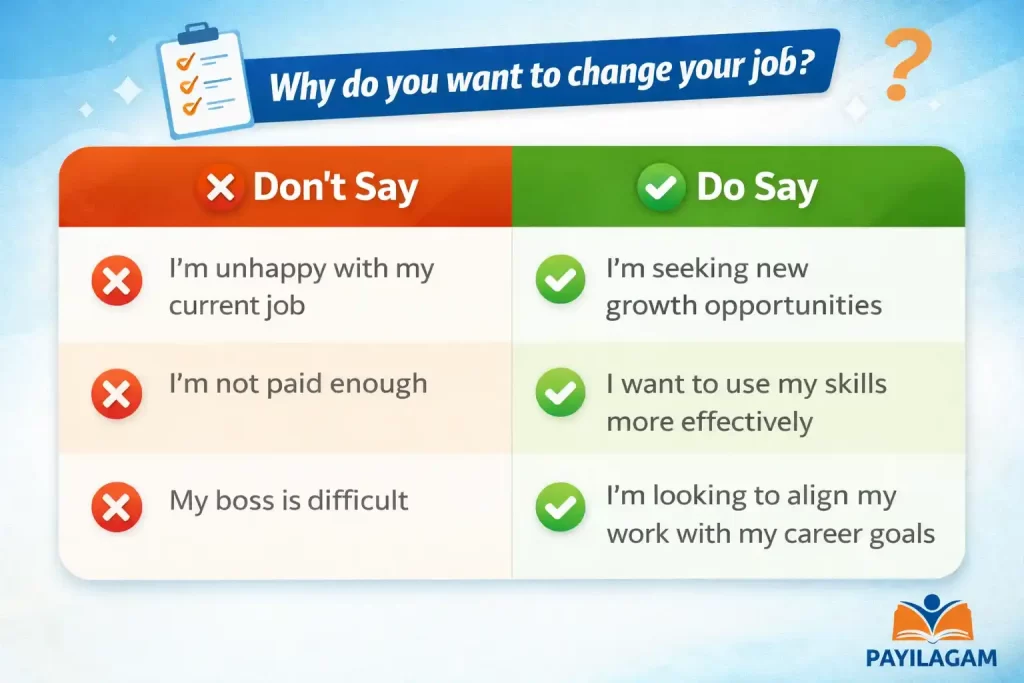
There are many situations where professionals decide to change jobs, and interviewers are well aware of this. What matters most is how clearly you explain the reason for changing jobs and whether it sounds thoughtful and professional. Below are the top 10 reasons that are commonly accepted during interviews.
- ☑️ Career growth opportunities are limited in the current role.
- ☑️ Lack of career advancement despite consistent performance.
- ☑️ Desire for a new challenge that supports learning and development.
- ☑️ Need for better job security and long-term stability.
- ☑️ Reduced job satisfaction in the current position.
- ☑️ Changes in the work environment or team structure.
- ☑️ Looking for a role that better aligns with career goals.
- ☑️ Limited exposure to new skills or responsibilities.
- ☑️ Seeking a better balance between personal life and work.
- ☑️ Exploring better job opportunities that support long-term growth.
These are some of the most common reasons for job transitions. When you explain your decision using one or more of these points, it becomes easier to justify your job change reason during a job interview. Always connect your explanation to what you are looking for next and how it supports your future plans.
Planning a job change but unsure how to explain it in interviews? 🎯
Payilagam offers career counselling to help you frame strong, professional answers that align with your career goals.
How to Explain Your Job Change in an Interview
Explaining a job change in an interview requires clarity, honesty, and a positive tone. Interviewers pay close attention to both your explanation and the way you communicate it. The goal is to clearly explain your reason for a job change while showing that your decision is thoughtful and aligned with your future plans. When answering this interview question, start by briefly acknowledging your current job or current role. Then shift the focus toward what you are seeking next. This helps interviewers understand that your decision is forward-looking and based on growth rather than dissatisfaction.
It’s important to keep your explanation structured. Begin with your experience, mention what you learned, and then explain why you are looking for a new job. This approach makes your answer sound natural and confident. Employers want to see that you have reflected on your experience and made a conscious career decision. Avoid blaming your current company or speaking negatively about your work environment. Even if challenges exist, focus on what you want to improve or achieve next. Interviewers respect candidates who handle sensitive topics professionally.
Most importantly, make sure your explanation aligns with your career goals and long-term direction. When your answer clearly shows purpose and planning, it becomes easier for interviewers to relate to your decision and see you as a strong fit.
How to Explain Leaving Your Current Job
- ☑️ Start by briefly mentioning your current role and the experience you gained from it.
- ☑️ Be respectful when talking about your current company and avoid negative comments.
- ☑️ Clearly state your reason for leaving in a professional and calm manner.
- ☑️ Focus on what you are looking for in a role that better supports your future plans.
- ☑️ Explain how your decision aligns with your career goals and long-term direction.
- ☑️ Keep the explanation simple and honest, without over-explaining details.
- ☑️ Emphasise learning, growth, or alignment rather than problems or dissatisfaction.
- ☑️ Show that leaving your current job is a thoughtful step, not a rushed decision.
Turning Your Reason for Leaving into a Positive
When explaining a job change, it’s important to frame your reason in a way that highlights growth and intention. Even if your decision was influenced by challenges, the focus should always remain on what you want to achieve next rather than what went wrong before. Start by acknowledging the value of your experience. You can mention that you enjoyed my time in the role and that your time at my current organization helped you build skills and confidence. This shows appreciation and professionalism, which interviewers value.
Next, clearly connect your reason for changing to the future. Explain that your decision aligns with my career goals and supports your long-term career goals. For example, you might say you are seeking responsibilities that better match your skills or opportunities that support professional growth. Using positive language is key. Focus on learning, exposure, and direction rather than limitations. When your explanation aligns perfectly with my career plans, interviewers see your job change as a thoughtful step toward progress, not a reaction to dissatisfaction.
By presenting your reason this way, you turn a potentially sensitive topic into a strong and confident response that supports your overall job interview performance.
Best Sample Answers for Job Change
Having clear sample answers prepared makes it easier to handle this interview question confidently. The key is to keep your response honest, professional, and aligned with your future plans. Below are example answers that show how to explain a job change in a positive and structured way.
Sample Answers for Freshers Looking for a Job
For freshers who are looking for a job, the focus should be on learning and direction rather than dissatisfaction.
Sample Answer:
“I’m looking for a role where I can learn more and build a strong foundation for my career. My previous job helped me understand the basics, but I now want to work in an environment that offers better exposure and aligns with my career goals. This change will help me grow professionally and move in the right direction.”
This answer works because it explains the reason for a job change clearly and shows motivation without negativity.
Sample Answers for Professionals Looking for a Job Change
Professionals who are looking for a job change should highlight experience, reflection, and future focus.
Sample Answer:
“I’ve gained valuable experience in my current role, and I’m grateful for what I’ve learned. At this stage, I’m looking for a new opportunity that offers greater responsibility and supports my long-term development. This decision aligns with my career aspirations and allows me to contribute more effectively.”
This response shows clarity, respect for the current job, and a forward-looking mindset. It also sounds like the best answer because it balances experience with ambition.
What Is the Best Answer to “Why Do You Want to Change Your Job?”
- ☑️ The best answer should be honest, professional, and future-oriented.
- ☑️ Briefly mention your current job or current role to provide context.
- ☑️ Clearly state the primary reason for your job change without negativity.
- ☑️ Focus on how the decision aligns with your career goals and long-term plans.
- ☑️ Highlight positive reasons such as growth, learning, or better alignment with your skills.
- ☑️ Avoid blaming your current company or criticising the work environment.
- ☑️ Show that the job change is a thoughtful step toward the right job, not an impulsive move.
- ☑️ Keep your explanation simple, confident, and relevant to the role you are applying for.
Mistakes to Avoid When Talking About a Job Change
Talking about a job change in an interview can easily go wrong if the answer is not framed carefully. Even when you have a genuine reason for changing, certain mistakes can create a negative impression during a job interview. One common mistake is speaking negatively about your current company or previous job. Complaining about managers, colleagues, or the work environment makes interviewers question professionalism. Employers want candidates who can handle change maturely, even when situations are challenging.
Another mistake is giving an unclear or inconsistent explanation. When candidates want to change jobs but cannot explain why clearly, it raises concerns about decision-making. Your answer should show purpose and direction, not confusion. Always connect your explanation to your career goals and future plans. Some candidates focus only on external benefits such as salary or perks. While these may matter, they should not be presented as the primary reason. Interviewers prefer to hear reasons related to growth, learning, and alignment with a new job rather than purely personal gain. Avoid sounding unsure or overly defensive. If you appear uncertain about your decision or over-justify it, interviewers may doubt your commitment. Keep your response confident, balanced, and forward-looking.
By avoiding these mistakes and focusing on clarity and professionalism, you can explain your job change in a way that builds trust and leaves a positive impression.
Final Thoughts on Job Change and Career Decisions
A job change is more than just moving from one role to another; it is a decision that can shape your long-term career direction. If interviewers ask, “Why do you want to change your job?”, they are trying to understand your clarity, intent, and readiness for the next step. Answering this question well requires self-reflection and a clear understanding of your goals.
Whether you are feeling stuck in your current role, seeking better growth, or looking for a role that aligns with your aspirations, it is important to approach the change thoughtfully. A well-planned job change should support learning, stability, and long-term satisfaction rather than short-term decisions.
This is where professional guidance can make a difference. Payilagam, the best software training institute in Chennai, supports individuals through career counselling by helping them evaluate their current situation, understand suitable career paths, and confidently explain their reasons during interviews. Proper counselling helps candidates make informed decisions and communicate their job change positively and clearly.
With the right mindset, preparation, and guidance, a job change becomes a strategic career move rather than a risky step. Taking time to reflect, seek advice, and plan ahead can help you move forward with confidence and choose opportunities that truly support your growth and future success.
Ready to take the next step in your career journey? 🚀
Connect with Payilagam for personalized career counselling and make your job change a confident career move.
FAQ: Job Change Interview Questions
1. Why do interviewers ask “Why do you want to change your job?”
This is a common interview question asked to understand your motivation, decision-making, and long-term direction. Employers want to know whether your job change is planned and how well it aligns with your career goals.
2. What is a valid reason for a job change?
A valid reason includes career growth, learning opportunities, a new challenge, better job security, or alignment with long-term goals. Interviewers prefer reasons that show clarity and positive intent rather than frustration.
3. How should I explain leaving my current job without sounding negative?
When leaving your current job, focus on what you are seeking next instead of what you disliked. Keep the explanation respectful and professional, and connect it to growth, learning, or future direction.
4. Is it okay to say I am looking for a job change due to personal reasons?
Yes, due to personal reasons can be acceptable if explained briefly and honestly. You don’t need to share details, just ensure your answer sounds reasonable and thoughtful.
5. How can career counselling help during a job change?
Career counselling helps you understand your strengths, clarify your career path, and confidently explain your job change in interviews. Guidance from experts, such as the counselling support offered by Payilagam, helps candidates make informed decisions and answer interview questions with confidence.